Nano Banana vs Seedream: Which to Use for Marketing Images
Nano Banana vs Seedream for marketing images: resolution, text, references, editing, API price and free access, from Google and ByteDance docs (Oct 2026).
Disclosure: Synthesys makes a competing AI video tool, and its Studio runs both model families. This comparison uses published information from Google and ByteDance, plus public leaderboards and other people's tests, checked on 1 October 2026. We haven't run our own test yet.
Nano Banana vs Seedream is a choice between two families of models, not two models. Many comparisons still test the 2025 versions. This one compares the four models you can use today, from the makers' own pages.
Picking an image model by its name is how teams end up paying for 4K they never use, or fixing the same headline five times. Pick by the job instead.
What is the difference between Nano Banana and Seedream?
Nano Banana is Google's family of Gemini image models, and Seedream is ByteDance's. Google's docs stress world knowledge, Search grounding and keeping people consistent. ByteDance's docs stress price per image, edits you point at and, on Seedream 5.0 Pro, splitting an image into layers.
These are the four current models this post compares:
- Nano Banana 2 (Gemini 3.1 Flash Image), launched on 26 February 2026. Google's docs call it the "generalist workhorse model for all tasks".
- Nano Banana Pro (Gemini 3 Pro Image), launched on 20 November 2025. Google calls it the "premium choice for the most complex visual tasks."
- Seedream 4.5, which ByteDance says improved multi-image editing and dense text rendering over 4.0.
- Seedream 5.0 Pro, launched on 8 July 2026 for infographics, marked-up edits, realistic portraits and more languages.
Each family also has a budget model: Nano Banana 2 Lite and Seedream 5.0 Flash. The original Nano Banana (Gemini 2.5 Flash Image) is deprecated. Google's pricing page set its API shutdown for 2 October 2026.
How do Nano Banana and Seedream compare on paper?
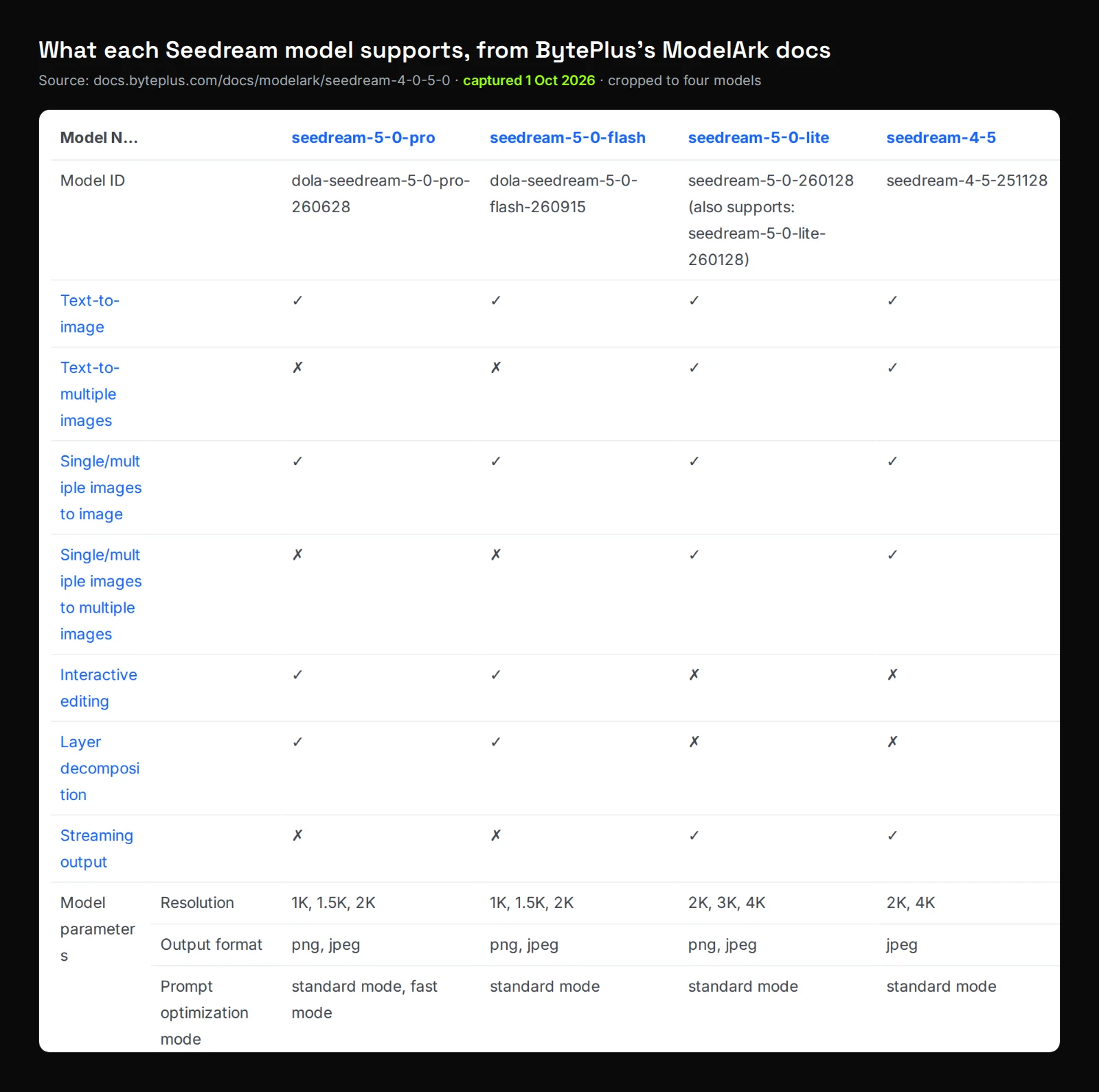
On published specs, Nano Banana reaches 4K on both current models and adds Google Search grounding. Seedream costs less per image through its API and, on 5.0 Pro, adds layers and marked-up edits. Seedream 5.0 Pro tops out at 2K, while Seedream 4.5 reaches 4K.
| Checked 1 Oct 2026 | Nano Banana 2 and Nano Banana Pro (Google) | Seedream 4.5 and Seedream 5.0 Pro (ByteDance) |
|---|---|---|
| Largest output | 4K (4096×4096) on both; Nano Banana 2 also offers 512px (Google docs) | 4K on 4.5 (2K or 4K tiers); 2K on 5.0 Pro (1K, 1.5K or 2K) (BytePlus docs) |
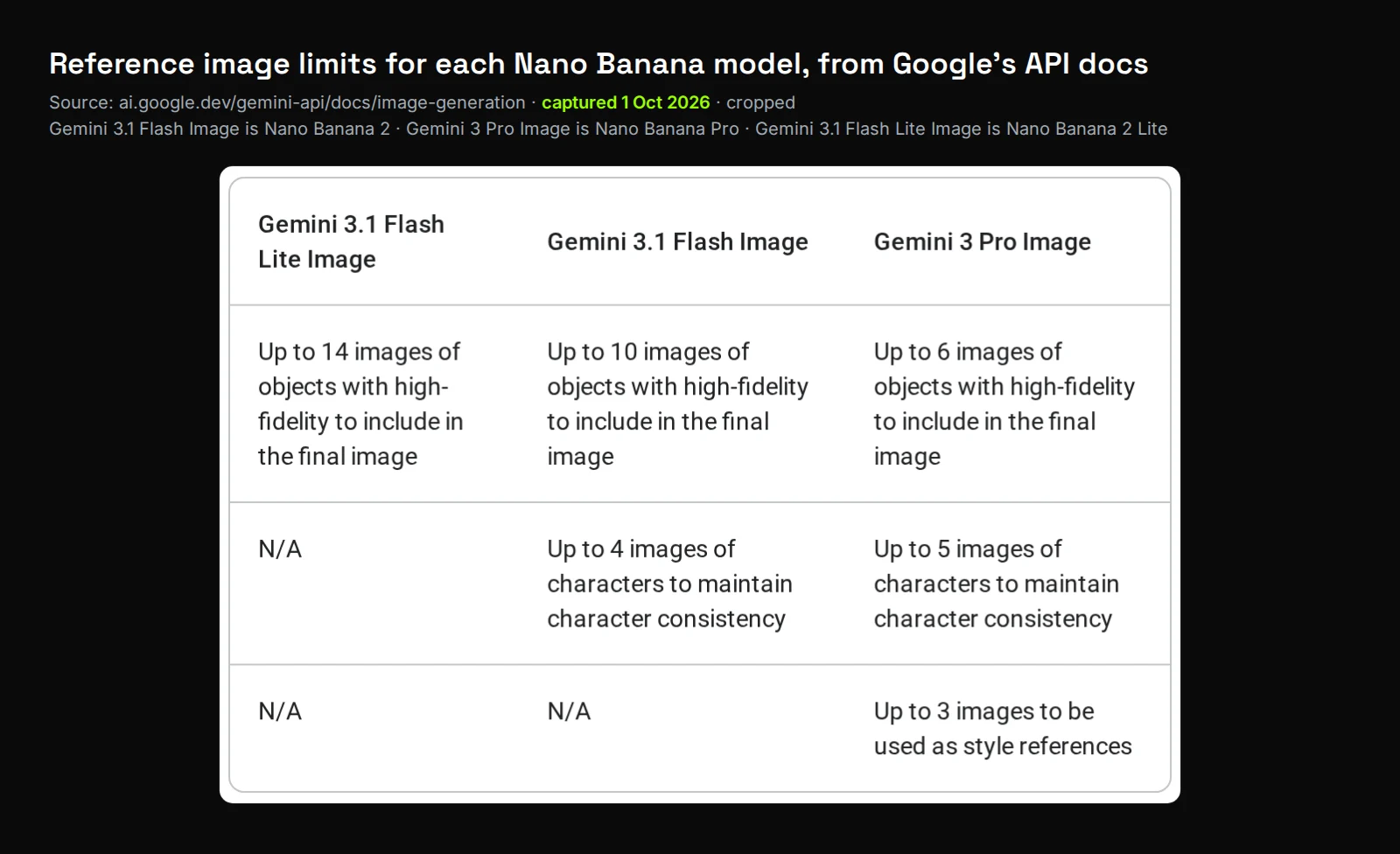
| Reference images | Up to 14 on both. Nano Banana 2: 10 objects and 4 characters. Pro: 6 objects, 5 characters and 3 style images (Google docs) | Up to 14 on 4.5 and up to 10 on 5.0 Pro (BytePlus docs) |
| Several images per request | Not guaranteed: Google says the model won't always return the number you ask for (Google docs) | 4.5: yes, with inputs plus outputs capped at 15. 5.0 Pro: one image, or a base image plus up to 16 layers (BytePlus docs) |
| Editing | Edits by conversation; Pro adds localized edits to a selected part (Google) | 5.0 Pro: edits placed with boxes, arrows or doodles, plus layer splitting. 4.5 has neither (BytePlus docs) |
| Web grounding | Google Search on both; Nano Banana 2 adds image search, but not for real people (Google docs) | None listed |
| Text languages | Best results in 15 listed languages, including Arabic, Hindi, Japanese and Chinese (Google docs) | 5.0 Pro: Chinese and English plus 14 more, including Arabic, Thai and Turkish (BytePlus docs) |
| Watermark | Invisible SynthID on every image (Google docs) | Visible "AI-generated" mark on by default in the API; you can switch it off (BytePlus docs) |
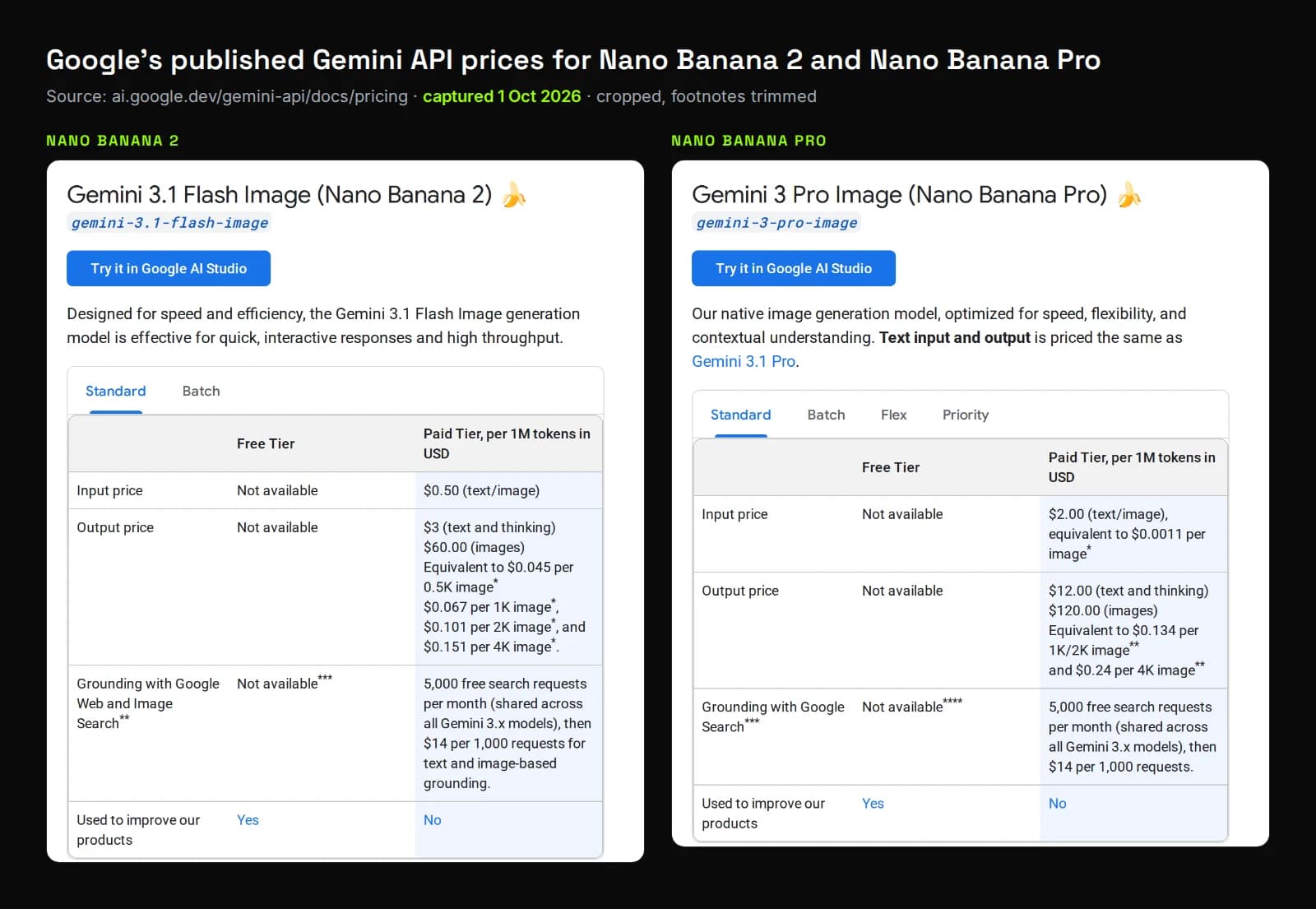
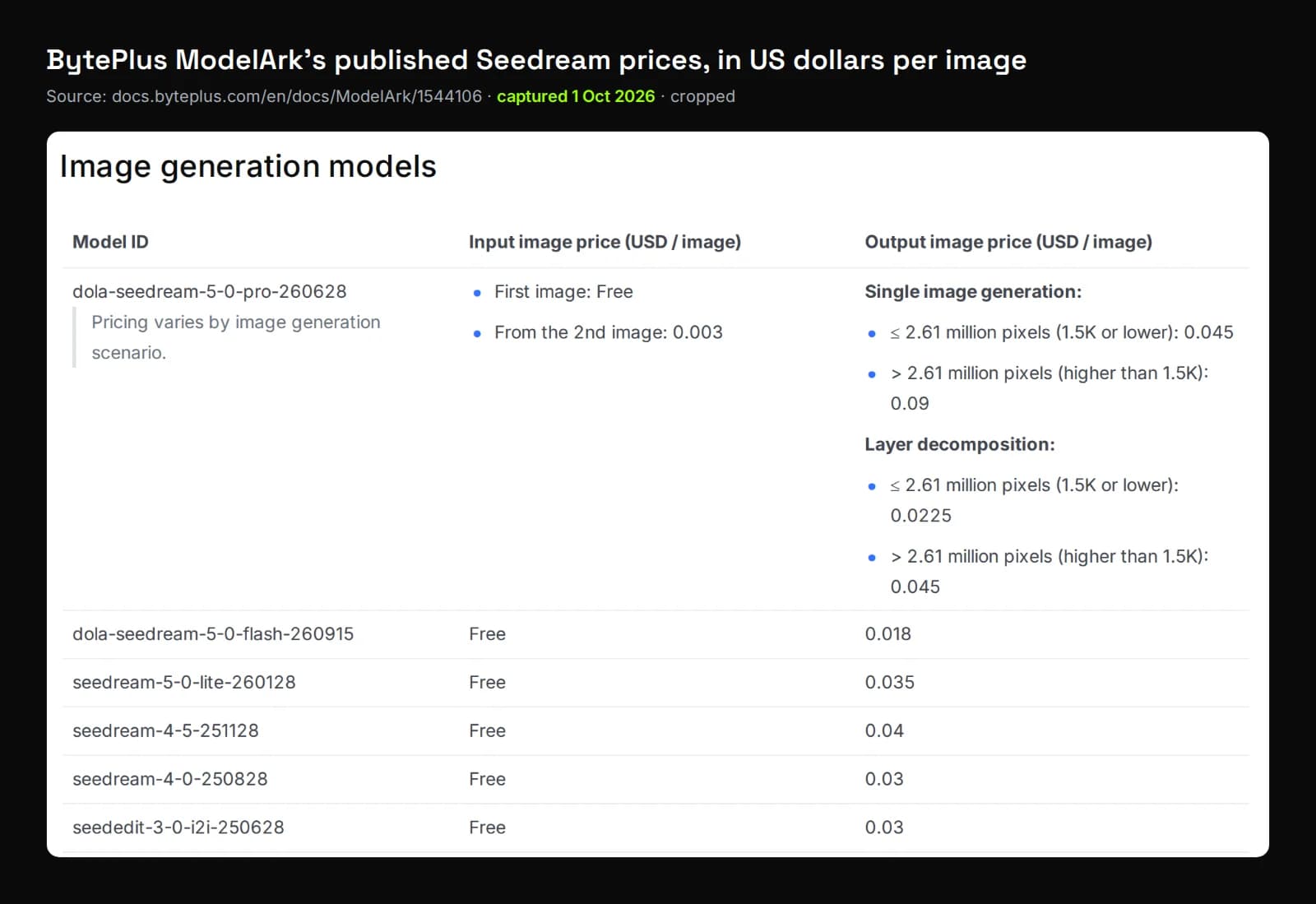
| API price per image | Nano Banana 2: $0.067 at 1K, $0.151 at 4K. Pro: $0.134 at 1K or 2K, $0.24 at 4K (Google pricing) | 4.5: $0.04. 5.0 Pro: $0.045 up to 1.5K, $0.09 above (BytePlus pricing) |
| Free route | Nano Banana 2 in the Gemini app without a paid plan, within usage limits. No free API tier (Google help) | Free starter tokens for new ModelArk users, per BytePlus |
| Output rights | Google "won't claim ownership" of generated content (Gemini API terms) | Licensed use, with an IP indemnity for permitted use of output; conditions apply (BytePlus terms) |
Prices and specs change often, so check both pages before you budget. BytePlus's terms say its own model services aren't available in the United States. US teams reach Seedream through platforms that host it, such as fal.
Which should you use for ad images with text in them?
Both makers say their newest models render text well, so neither wins on paper. Google pitches Nano Banana Pro for legible text, from a short tagline to a long paragraph. ByteDance pitches Seedream 5.0 Pro for dense infographics, and says finer text rendering still has room to improve.
So run your real headline, prices and any accented words through both before a campaign. The test brief below does that.
Language lists differ, and that can settle it. Google lists Hindi, Italian and Ukrainian among its best-performing languages. BytePlus lists Thai, Turkish, Filipino and Malay for Seedream 5.0 Pro.
Which keeps a product or a person the same across images?
Nano Banana publishes the clearest limits here: up to 14 reference images, with up to 4 people on Nano Banana 2 and 5 on Pro. Seedream 4.5 takes up to 14 references and 5.0 Pro up to 10, but ByteDance gives no separate count for people.
Google's launch post for Nano Banana 2 said up to five people and 14 objects. The API docs, updated in September, list 4 and 10, so plan for the lower numbers. Nano Banana Pro also takes up to 3 style references, which helps when a campaign has a fixed look. Seedream 4.5 can return a matching set of images from one request. On 4.5, reference images plus generated images can't pass 15 per request.
Which is easier to fix after the first render?
Seedream 5.0 Pro gives you the most published control. Mark the spot to change with a box, arrow or doodle. Then split the image into a base and up to 16 transparent layers. Nano Banana edits by conversation: you describe the change, and Pro adds localized edits.
Layers matter when a designer finishes the image in another tool. Seedream 4.5 has neither feature, per the same BytePlus table. ByteDance also says pixel-level editing consistency still has room to improve.
Which costs less per image?
Through the official APIs, Seedream costs less per image. Seedream 4.5 lists $0.04 an image and Seedream 5.0 Pro $0.045 up to 1.5K. Nano Banana 2 lists $0.067 at 1K, and Nano Banana Pro $0.134 at 1K or 2K. All four prices were checked on 1 October 2026.
What 100 images cost at list price, output only:
| 100 images on… | Published API cost |
|---|---|
| Seedream 4.5 at 2K (its smallest size) | $4.00 |
| Seedream 5.0 Pro at 1.5K | $4.50 |
| Seedream 5.0 Pro at 2K | $9.00 |
| Nano Banana 2 at 1K | $6.70 |
| Nano Banana 2 at 4K | $15.10 |
| Nano Banana Pro at 1K or 2K | $13.40 |
| Nano Banana Pro at 4K | $24.00 |
Google also charges for input tokens, and for Search grounding past 5,000 free requests a month (Google pricing). Seedream 5.0 Pro charges $0.003 for each reference image after the first (BytePlus pricing). The budget models cost less again: Seedream 5.0 Flash lists $0.018, and Nano Banana 2 Lite about $0.034 per 1K image.
Can you use Nano Banana or Seedream for free?
Nano Banana 2 is free to try in the Gemini app within usage limits, without a paid Google AI plan. Neither Nano Banana model has a free tier in the Gemini API. For Seedream, BytePlus advertises free starter tokens for new ModelArk users.
Google's help page lists Nano Banana 2 image generation on every plan, with higher limits on paid ones. Google's Nano Banana Pro post adds a visible mark to images on free and AI Pro plans. Ultra subscribers and Google AI Studio get images without it.
Where is Nano Banana better?
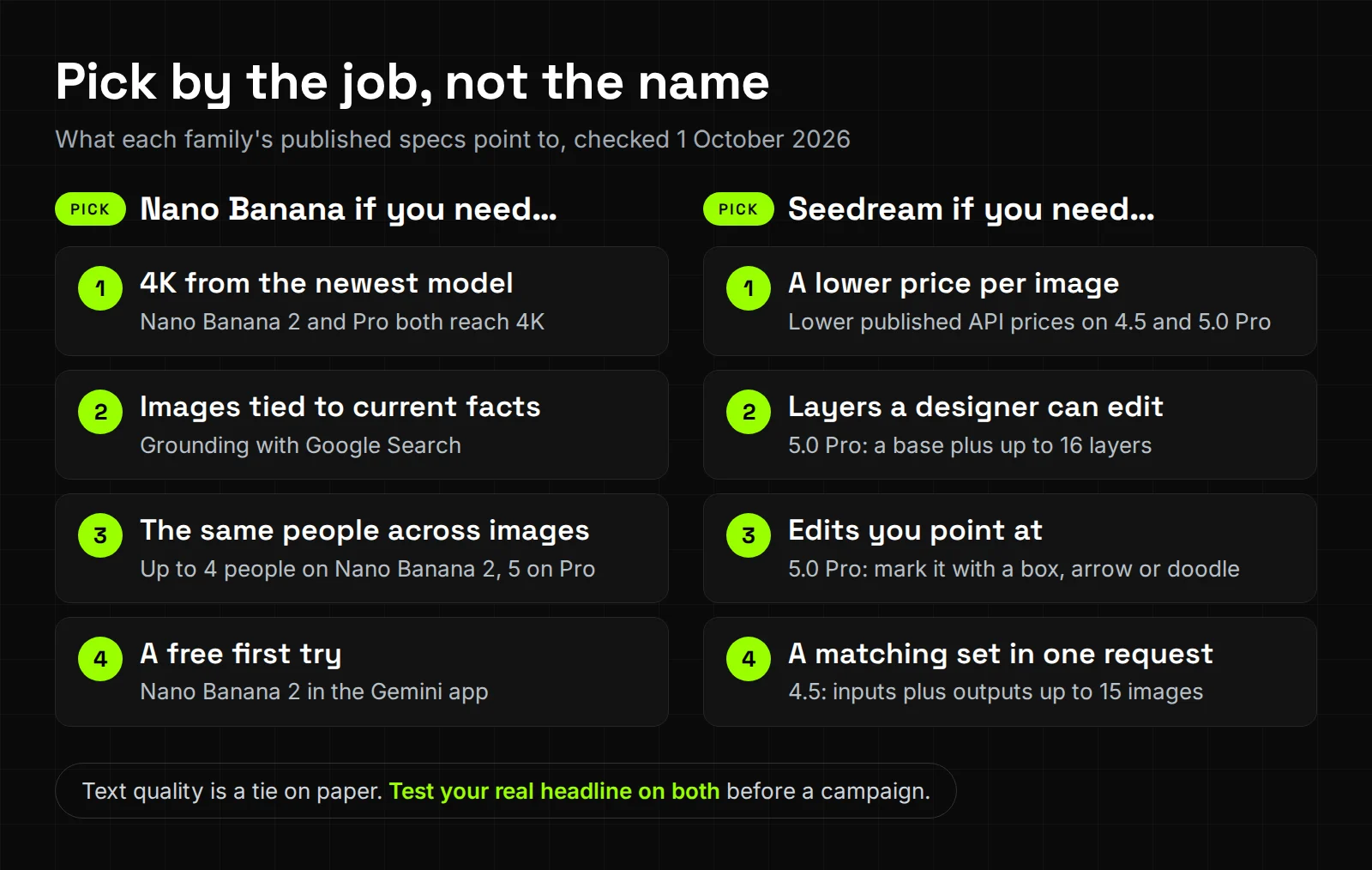
- 4K from the newest models. Both current Nano Banana models reach 4K. Seedream's newest, 5.0 Pro, stops at 2K.
- Current facts. Google Search grounding helps with images built on recent data, like a weather map.
- Clear limits for people. Google publishes how many characters each model keeps consistent: 4 or 5.
- A free start. You can try Nano Banana 2 in the Gemini app without a paid plan.
Where is Seedream better?
- Price per image. Both Seedream models list lower API prices than either Nano Banana model at similar sizes.
- Layers. Seedream 5.0 Pro splits an image into up to 16 transparent layers a designer can move or recolor.
- Pointed edits. On 5.0 Pro you mark the spot with a box, arrow or doodle instead of describing it.
- Sets. Seedream 4.5 returns several matching images from one request.
- Some languages. Thai, Turkish, Filipino and Malay are on ByteDance's list, not Google's.
What do side-by-side tests show?
Published tests point to a near tie. On Arena's public leaderboard, Nano Banana 2 and Seedream 5.0 Pro score within five points of each other. Testers tend to favor Nano Banana for realistic products and people, and Seedream 5.0 Pro for dense layouts and precise edits.
| Who tested, and when | Models | What they found |
|---|---|---|
| Arena text-to-image leaderboard, public votes, 24 Sep 2026 | All four | Nano Banana 2 (with web search) 1261, Seedream 5.0 Pro 1256, Nano Banana Pro 1247, Seedream 4.5 1147. The top two overlap |
| Arena image edit leaderboard, public votes, 29 Sep 2026 | All four | Seedream 5.0 Pro 1394, Nano Banana Pro 1390, Nano Banana 2 1387, Seedream 4.5 1302. The top three overlap |
| Soku AI, 5 paid-social briefs, 9 Jul 2026 | Nano Banana 2, Seedream 5.0 Pro | Nano Banana 2 gave the most natural product scenes. Seedream 5.0 Pro won dense layouts, but "invented extra ad copy and price-like text" |
| 302.AI, 6 cases, 28 Feb 2026 | Nano Banana 2, Seedream 5.0 (before 5.0 Pro) | Nano Banana 2 won 5 of 6. Seedream won the infographic with Chinese text |
| 302.AI, 6 cases, 5 Dec 2025 | Nano Banana Pro, Seedream 4.5 | Nano Banana Pro won 4 of 6, mostly knowledge-heavy images. Seedream 4.5 won 2 on photo look, like a film-grain street shot |
Soku and 302.AI both sell access to these models. Arena ranks models by blind public votes. On both Arena boards, both families trail OpenAI's GPT Image 2.
Testing it yourself? Give each model the same prompt, shape and resolution. Try a product label, a two-language poster, a three-reference scene and one small edit.
Is there a third option?
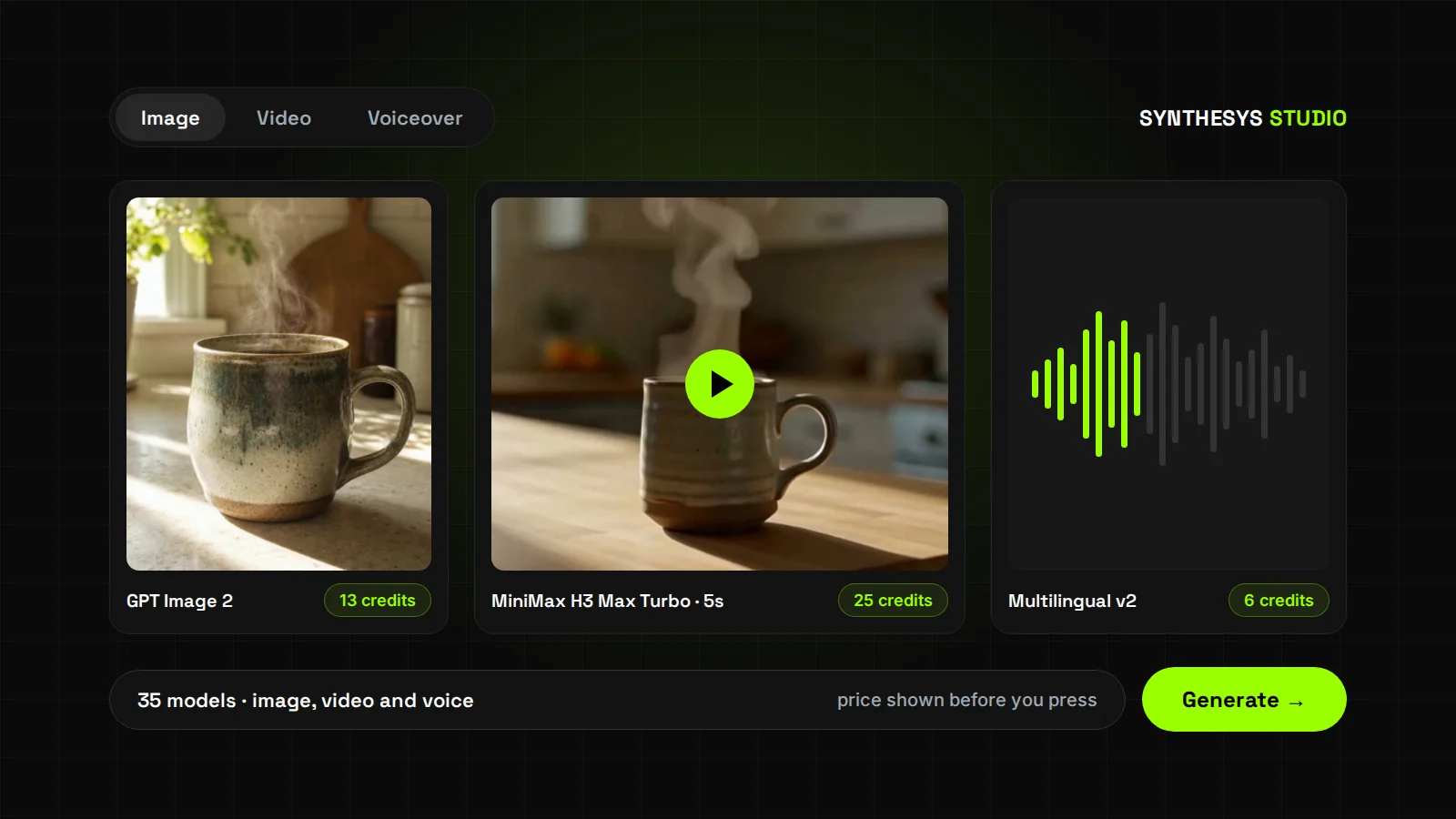
Synthesys is an AI video agent that replaces traditional video production end to end. Its Studio runs all four models in this post, so you can try both families in one place and see the credit price first. If you need API access for your own app, go to Google or BytePlus directly. If the image is headed into a video, the AI video agent can take it from there.
Try Synthesys Studio · See plans
Which would we pick, and for what?
For product shots and anything with real people, we'd start with Nano Banana 2. For dense layouts, menus and infographics, we'd start with Seedream 5.0 Pro. For a lot of cheap first drafts, Seedream 4.5.
- Product and lifestyle shots: Nano Banana 2. Step up to Pro for several recognizable people or 4K print.
- Ad posters with text: a short headline goes to Nano Banana, long structured copy to Seedream 5.0 Pro. Proofread every word either way.
- Handing off to a designer: Seedream 5.0 Pro, for the layers.
If we had to name one thing each does better: Nano Banana makes a product look photographed, not generated. Seedream lets you fix one spot without rerolling the whole image.
Sources
All pages were opened and checked on 1 October 2026.
- Google AI for Developers, Gemini Developer API pricing (page updated 1 Oct 2026)
- Google AI for Developers, Image generation with Gemini (Nano Banana) (updated 23 Sep 2026)
- Google, Nano Banana 2: Google's latest AI image generation model (26 Feb 2026)
- Google, Build with Nano Banana 2 (26 Feb 2026)
- Google, Nano Banana Pro: Gemini 3 Pro Image model (20 Nov 2025)
- Google, Gemini Apps limits and upgrades
- Google, Gemini API Additional Terms of Service (updated 28 Apr 2026)
- ByteDance Seed, Introducing Seedream 5.0 Pro (8 Jul 2026)
- ByteDance Seed, Seedream 4.5
- BytePlus, ModelArk model billing (updated 28 Sep 2026)
- BytePlus, ModelArk image generation tutorial (updated 28 Sep 2026)
- BytePlus, Seedream 5.0 pro / flash tutorial (updated 28 Sep 2026)
- BytePlus, Image generation API reference (updated 28 Sep 2026)
- BytePlus, ModelArk product page
- BytePlus, Service Specific Terms (updated 30 Sep 2026)
- fal, Nano Banana vs. Seedream (25 Mar 2026), used only to show a platform that hosts Seedream
- Arena, Text-to-Image leaderboard (updated 24 Sep 2026)
- Arena, Image Edit leaderboard (updated 29 Sep 2026)
- Soku AI, Seedream 5.0 Pro vs GPT Image 2 (and Nano Banana 2) for Ad Creative (9 Jul 2026)
- 302.AI, Nano Banana 2 vs. Seedream 5.0 Test (28 Feb 2026)
- 302.AI, Seedream 4.5 vs Nano Banana Pro (5 Dec 2025)
- Synthesys, Synthesys Studio: 35 AI Models for Image, Video and Voice (30 Sep 2026)