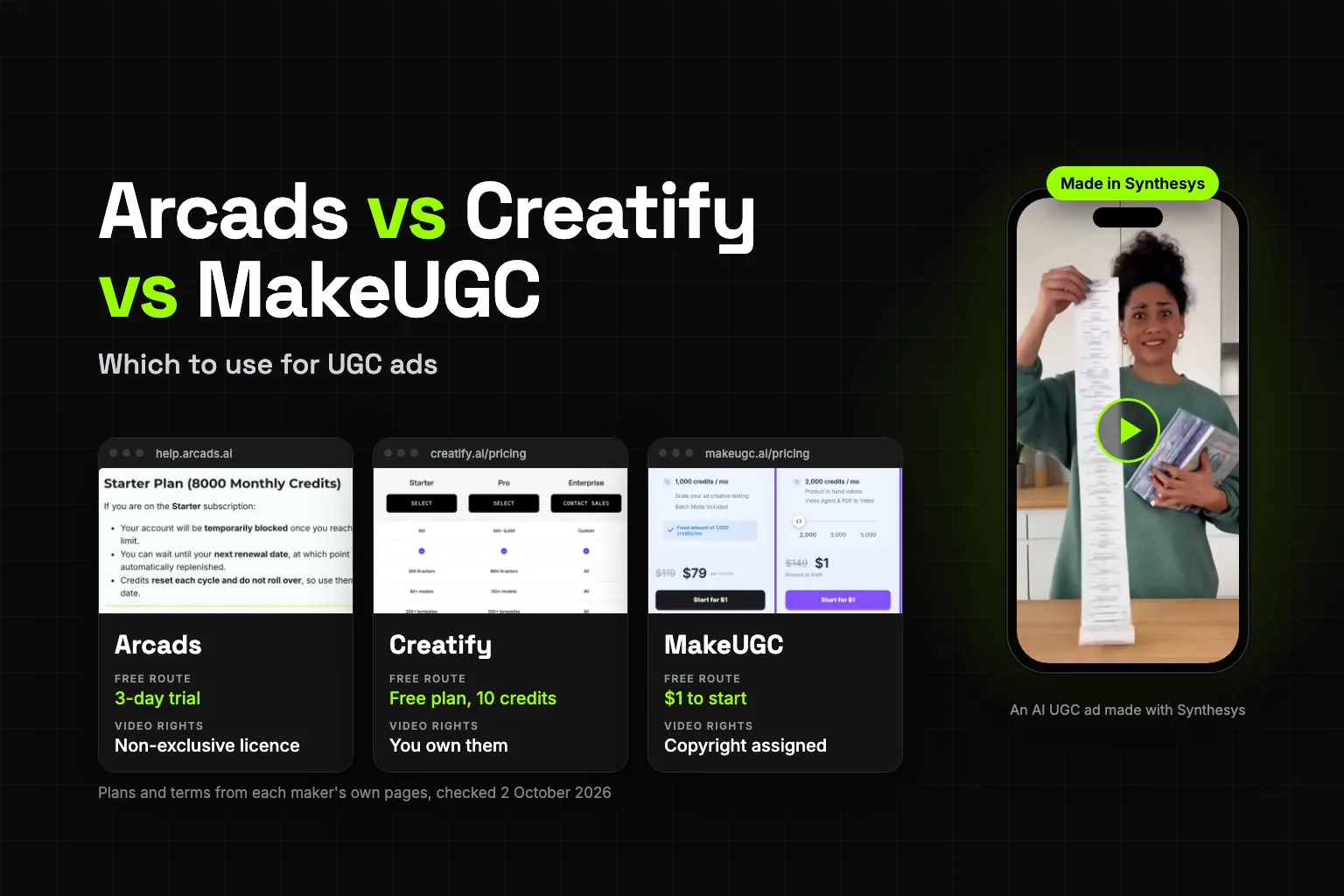
Arcads vs Creatify vs MakeUGC: Which to Use for UGC Ads
Arcads vs Creatify vs MakeUGC: AI actors, video length, trials, published prices, API and video rights, from each maker's own pages, checked 2 Oct 2026.
Disclosure: Synthesys makes a competing AI video tool that also makes UGC-style ads. None of these three tools runs inside Synthesys. This comparison uses each maker's own website, help center, pricing page and terms, checked on 2 October 2026. We haven't run our own side-by-side test yet.
Arcads vs Creatify vs MakeUGC is a choice between three tools for one job: AI actors who read your ad script to camera. The differences sit in prices, video rights, length limits and workflow. This post uses only the makers' own pages, linked and dated.
Most people pick a UGC tool by scrolling the actor library. We'd check two things first: what a month of testing costs, and whether you own the ad that wins.
What is the difference between Arcads, Creatify and MakeUGC?
All three turn a script into a video of an AI actor talking to camera. Arcads centres on actors, talking-actor models and a workflow canvas. Creatify adds ad tools: URL-to-video, ad cloning and launching to ad platforms. MakeUGC adds product-in-hand videos and recreating proven ad formats.
- Arcads is built by FRESHR, a French company (terms). Its platform guide lists three talking-actor models and video models such as Veo 3.1, Kling 3.0 and Seedance 2.0.
- Creatify has its own Aurora avatar model and 100+ premium AI models on Pro (pricing).
- MakeUGC is run by Cinnamon Technology Limited in England (terms). It adds product-in-hand videos and a library of ad formats to recreate (homepage).
How do Arcads, Creatify and MakeUGC compare on paper?
On published facts, Creatify is the easiest to try free and the clearest on video length. MakeUGC is the most open about prices. Arcads documents its models in the most detail but lists no prices, and it licenses videos to you rather than handing over ownership.
| Checked 2 Oct 2026 | Arcads | Creatify | MakeUGC |
|---|---|---|---|
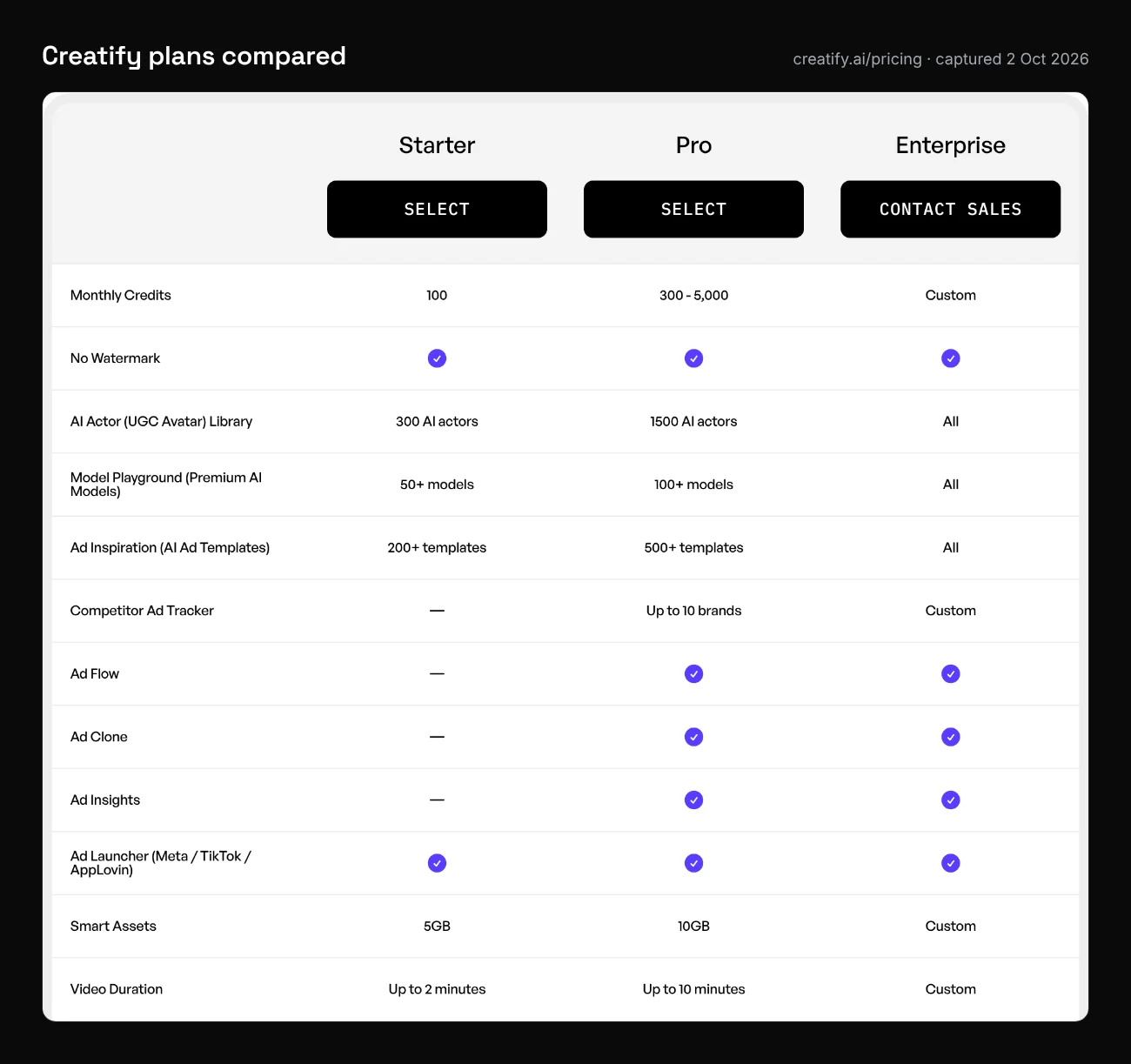
| AI actors | 1,000+ (homepage) | 300 on Starter, 1,500 on Pro (pricing) | 1,000+ (pricing) |
| Your own actor | Custom actor from one headshot; face-and-voice clone on Pro (guide) | From a photo or a description; 3 custom avatars on Pro (avatars, pricing) | Trained from a short video of you (custom avatar) |
| Languages | 30+ for translation (homepage) | 75+ (pricing FAQ) | 50+ (pricing) |
| Video length | Per model: 8 s on Veo 3.1, 15 s on Kling 3.0; no fixed cap for talking actors (help) | Up to 2 min on Starter, 10 min on Pro (pricing) | API scripts up to 1,500 characters; uploaded audio up to 120 s (API docs) |
| Free route | 3-day trial, then the Starter plan is charged (help) | Free plan: 10 credits a month, watermarked (pricing) | $1 to start, then the plan price (pricing) |
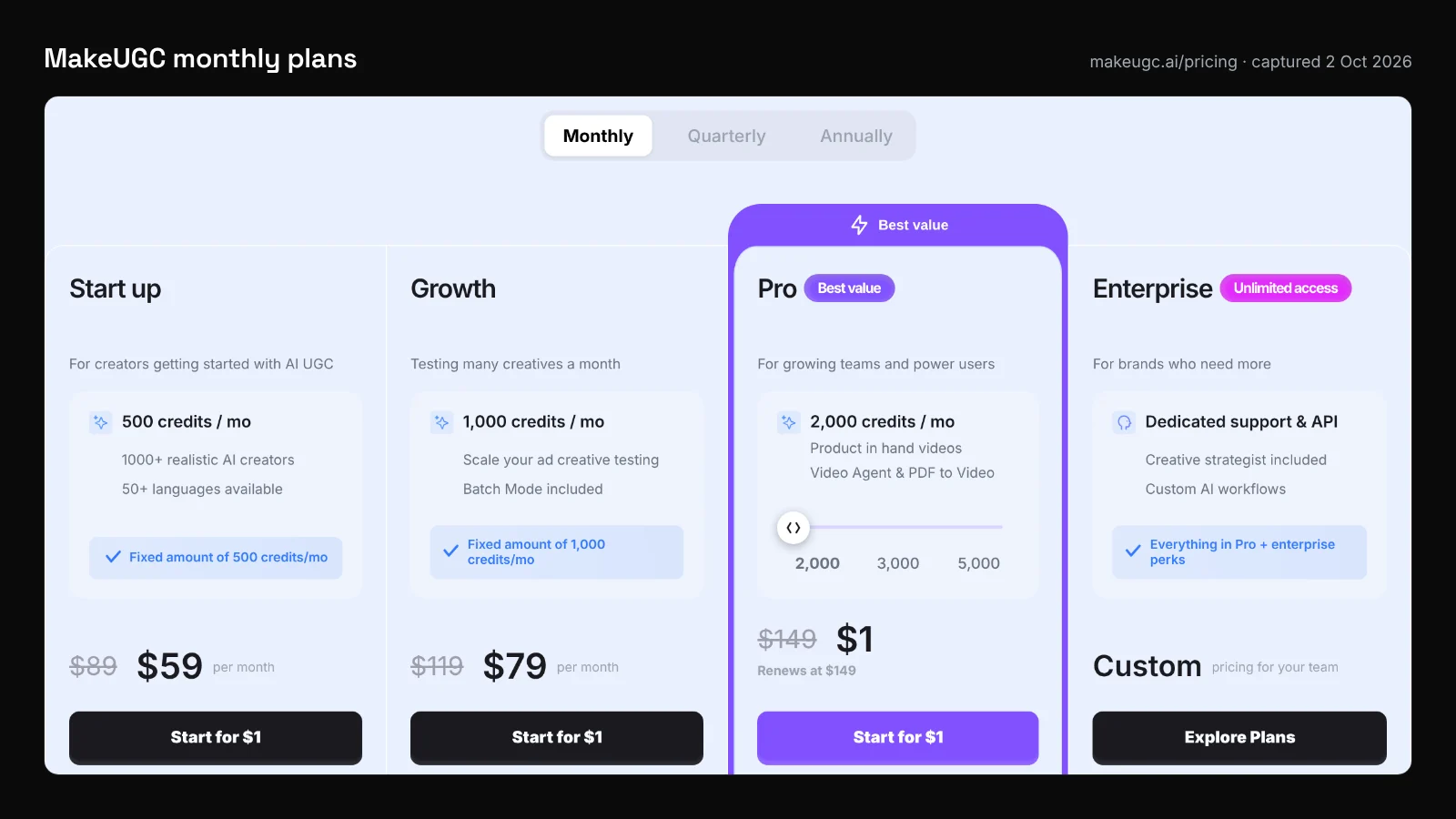
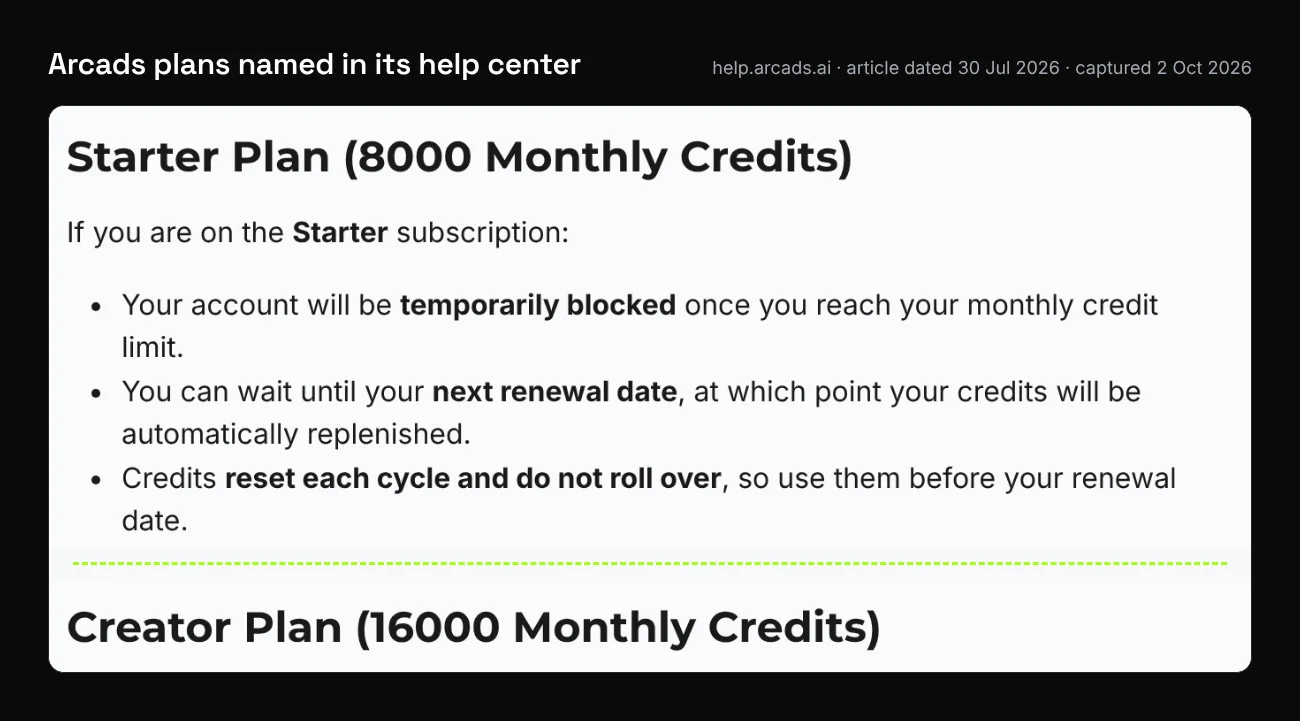
| Published monthly price | Not on its website; plans named Starter (8,000 credits) and Creator (16,000) (help) | Starter $39 for 100 credits; Pro from $99 for 300 (pricing) | Start up $89, Growth $119, Pro $149 (list prices) (pricing) |
| API | Yes, with API credentials (docs); MCP server (docs) | From $99 a month for 500 API credits (pricing) | API Starter $149 a month for 2,000 credits (list price) (pricing) |
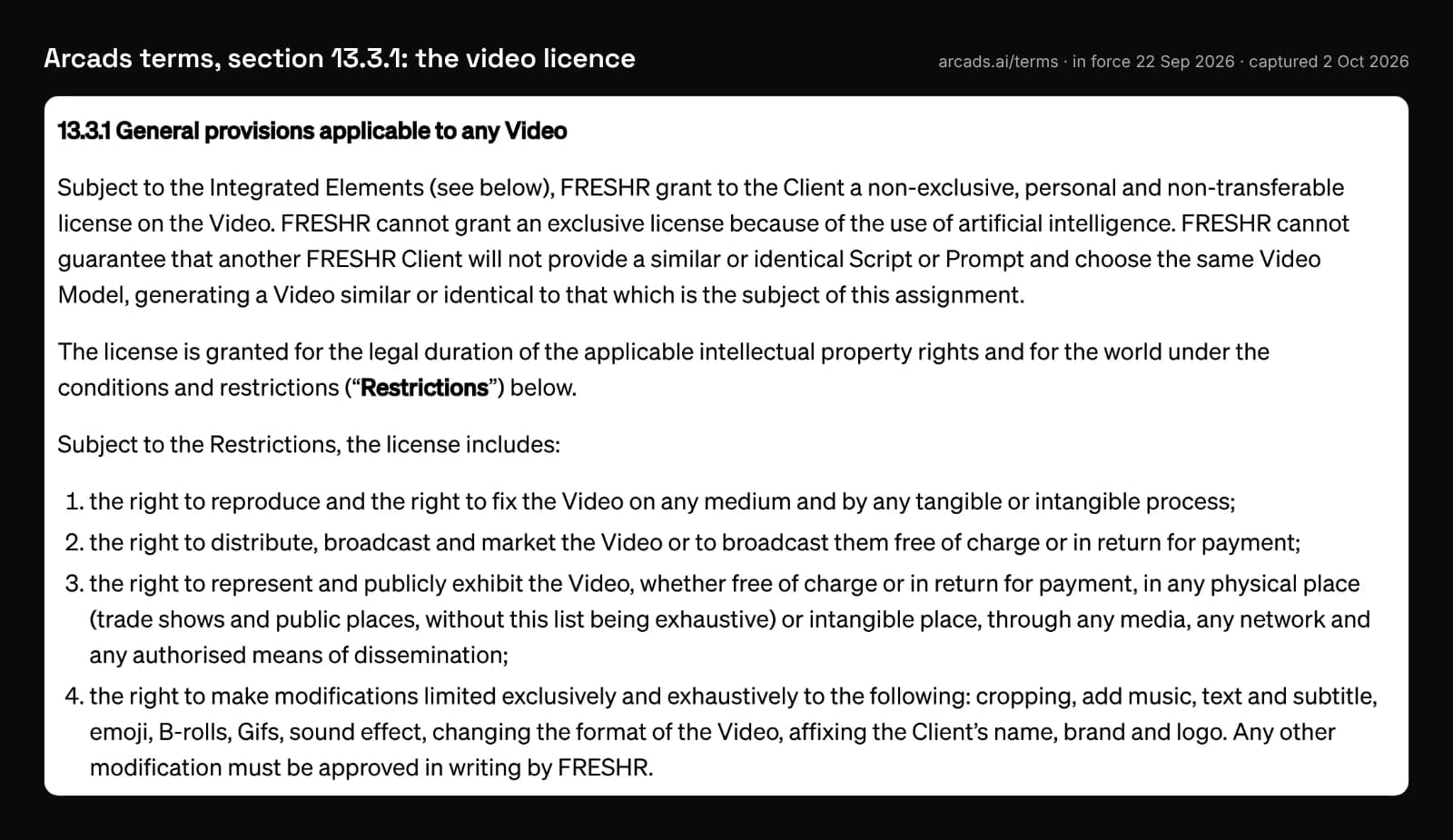
| Video rights | Non-exclusive, non-transferable licence; edits limited to a list (terms, 13.3) | "You own all of your creatives" (pricing FAQ) | Copyright assigned to you (terms, 3.2) |
MakeUGC was showing discounts when we checked: $59 and $79 for its first two plans, and $1 for the first month of Pro.
Which is cheapest to start with?
Creatify, if you want to try before paying. Its free plan gives 10 credits a month, with a watermark. MakeUGC costs $1 to start, then $89 to $149 a month at list price. Arcads has a 3-day trial but publishes no prices.
Credits don't compare across tools, because each prices by model, length and resolution:
| Credits, checked 2 Oct 2026 | Arcads | Creatify | MakeUGC |
|---|---|---|---|
| Entry plan | Starter: 8,000 a month | Starter: 100 a month | Start up: 500 a month |
| Unused credits | Reset each cycle on Starter and Creator; roll over on Pro and up (help) | Valid for 2 months (pricing FAQ) | Expire at the end of the month (pricing FAQ) |
Which has the most realistic AI actors?
We can't judge realism from spec sheets, and our side-by-side test hasn't run yet. On paper, Arcads gives you the most actor models to choose from: Arcads 1.0, Audio-Driven and OmniHuman 1.5. Creatify has its own Aurora model. MakeUGC's API docs name Nova V2 and Omi-Human for product-in-hand videos.
Arcads' guide suggests Arcads 1.0 for volume, OmniHuman 1.5 for the most lifelike motion, and Audio-Driven when you already have a voiceover. Another help article notes OmniHuman can exaggerate movements (help).
Creatify says emotion tags such as [laugh] change an avatar's face and tone (avatars). MakeUGC's actors can hold your product and copy a source video's movements (homepage).
When you compare them, look past the face. Hands, product labels and the last words of a line are where AI actors tend to slip.
Can you make your own AI actor or clone yourself?
Yes, in all three. Arcads builds a custom actor from one headshot and, on Pro, clones your face and voice from a 2-minute video. Creatify makes an avatar from a photo or a written description. MakeUGC trains one from a short video of you speaking.
Arcads asks for at least 2 minutes of continuous speech in one take, with your face visible throughout. Each cloned video costs 1,600 credits (help). Creatify's Pro plan includes 3 custom avatars (pricing). MakeUGC's API charges 100 credits per custom avatar (API docs).
Clone only people who have agreed to it. Arcads' terms also forbid using its stock actors to clone or alter the real person behind them (terms, 13.3.2).
Which handles longer videos and other languages?
Creatify is the clearest: videos up to 2 minutes on Starter and 10 on Pro, in 75+ languages. Arcads sets length per model and offers an Extend Video tool and translation with lip sync. MakeUGC lists 50+ languages and caps API scripts at 1,500 characters.
Arcads suggests OmniHuman 1.5 for scripts up to about 400 characters, Audio-Driven up to 600, and Arcads 1.0 for 1,500 or more (help).
For a 20 to 30-second ad, all three are long enough.
Which fits a performance-marketing team?
Creatify covers the most of the ad loop on its own pages: competitor tracking, ad cloning, and launching to Meta, TikTok and AppLovin. Arcads leans on workflows, an API and an MCP server. MakeUGC leans on batch generation, recreating proven formats and an API.
- Creatify: Ad Clone and the competitor tracker (up to 10 brands) are on Pro. The Ad Launcher is on every paid plan (pricing).
- Arcads: one workflow can run a script across 10 actors in 2 languages, 20 clips in one run (guide). Its MCP server connects to Claude Desktop.
- MakeUGC: Batch Mode starts on Growth. Video Agent, which rebuilds a reference ad with your product, is listed on Pro (pricing). Its API docs include an MCP route (docs).
Who owns the videos, and what can you do with them?
Creatify and MakeUGC say the videos are yours. Arcads grants a non-exclusive, non-transferable licence instead. It limits edits to a set list, and a stock actor's creator can restrict uses or ask for videos to be removed.
Arcads' terms allow cropping, music, text, subtitles, emoji, B-roll, GIFs, sound effects, format changes and your branding. Other changes need written approval. Arcads says it can't grant exclusivity, because another client could generate a near-identical video (terms, 13.3).
Creatify's pricing FAQ says you own your creatives, even after your plan ends. MakeUGC's terms assign copyright in the output to you, and make you responsible for your ads' compliance.
Are AI UGC ads allowed?
AI actors aren't banned, but the ad can't mislead. The US Federal Trade Commission's 2024 rule bans testimonials that misrepresent they're by someone who doesn't exist, such as AI-generated fake reviews. An AI actor presented as a real customer is the risk, whichever tool made it.
The FTC announced the rule in August 2024. A creator-style product demo is different from a fake review. This isn't legal advice, so check the rules where you advertise.
Where is Arcads better?
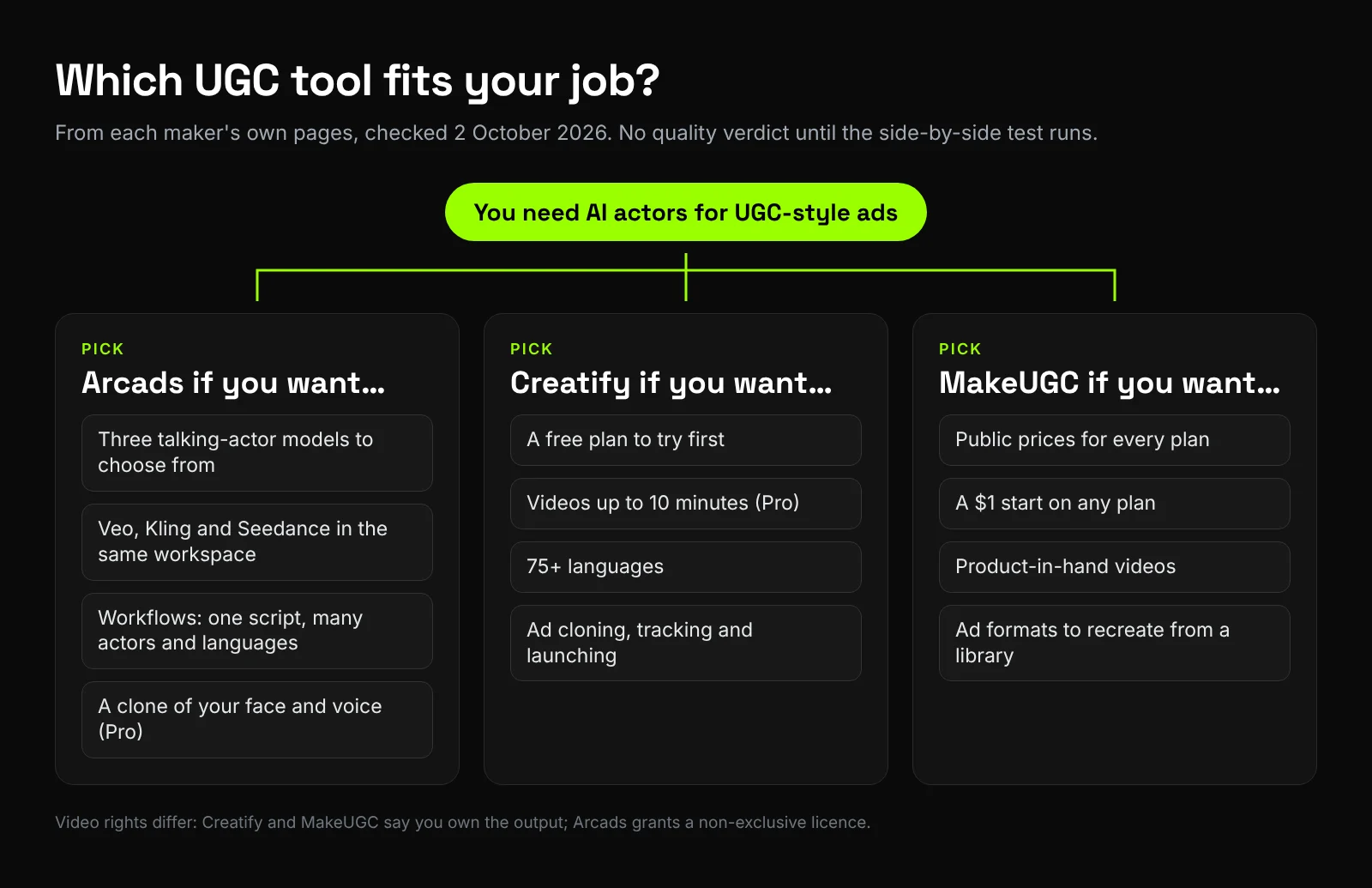
- Actor models. Three to choose from, with trade-offs documented.
- Workflows. One script across many actors and languages in one run.
- Cloning yourself. Face and voice from one 2-minute video, on Pro.
Where is Creatify better?
- Trying it free. The only free plan of the three.
- Clear length limits. 2 minutes on Starter, 10 on Pro.
- The ad loop. URL to video, Ad Clone, tracking and launching.
- Languages. 75+, the highest published count.
Where is MakeUGC better?
- Public prices. Every self-serve and API plan is listed.
- A $1 start. On every plan.
- Products in hand. Plus a library of ad formats to recreate.
- Ownership. Copyright in the output is assigned to you.
How can you test all three before you pay?
Run the same script and product through each tool's cheapest route. Creatify's free plan makes around 2 watermarked video ads. MakeUGC starts at $1 and Arcads offers a 3-day trial. Both renew at the full plan price unless you cancel, so set a reminder.
Keep the settings identical: 9:16, one actor type, default voice, no captions or music.
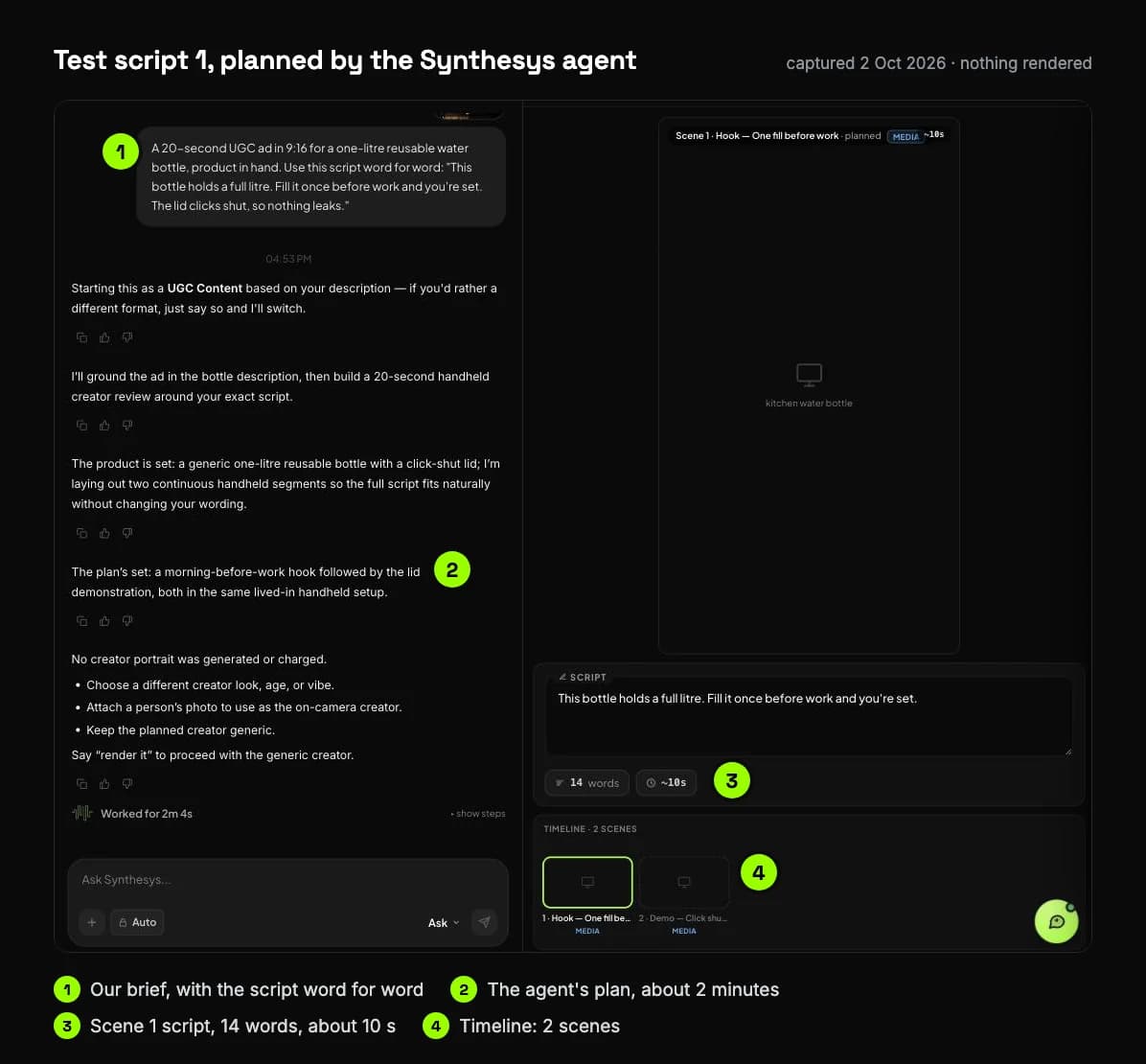
- Product in hand, about 20 seconds: "This bottle holds a full litre. Fill it once before work and you're set. The lid clicks shut, so nothing leaks."
- A short app demo: "Here's how to plan a week of dinners in five minutes. Pick three meals, and the app builds the shopping list."
- The first script in Spanish, to check the voice and lip sync.
Compare the exports side by side, and note credits and minutes.
Is there a third option?
Synthesys is an AI video agent that replaces traditional video production end to end. For a UGC ad, it starts from one sentence, a product page or App Store link, or a competitor's ad. It returns a storyboard with the script and the credit cost before anything renders, and a failed render costs nothing (AI video agent). You can cast a library presenter or your own digital twin, and export 9:16, 16:9 or 1:1.
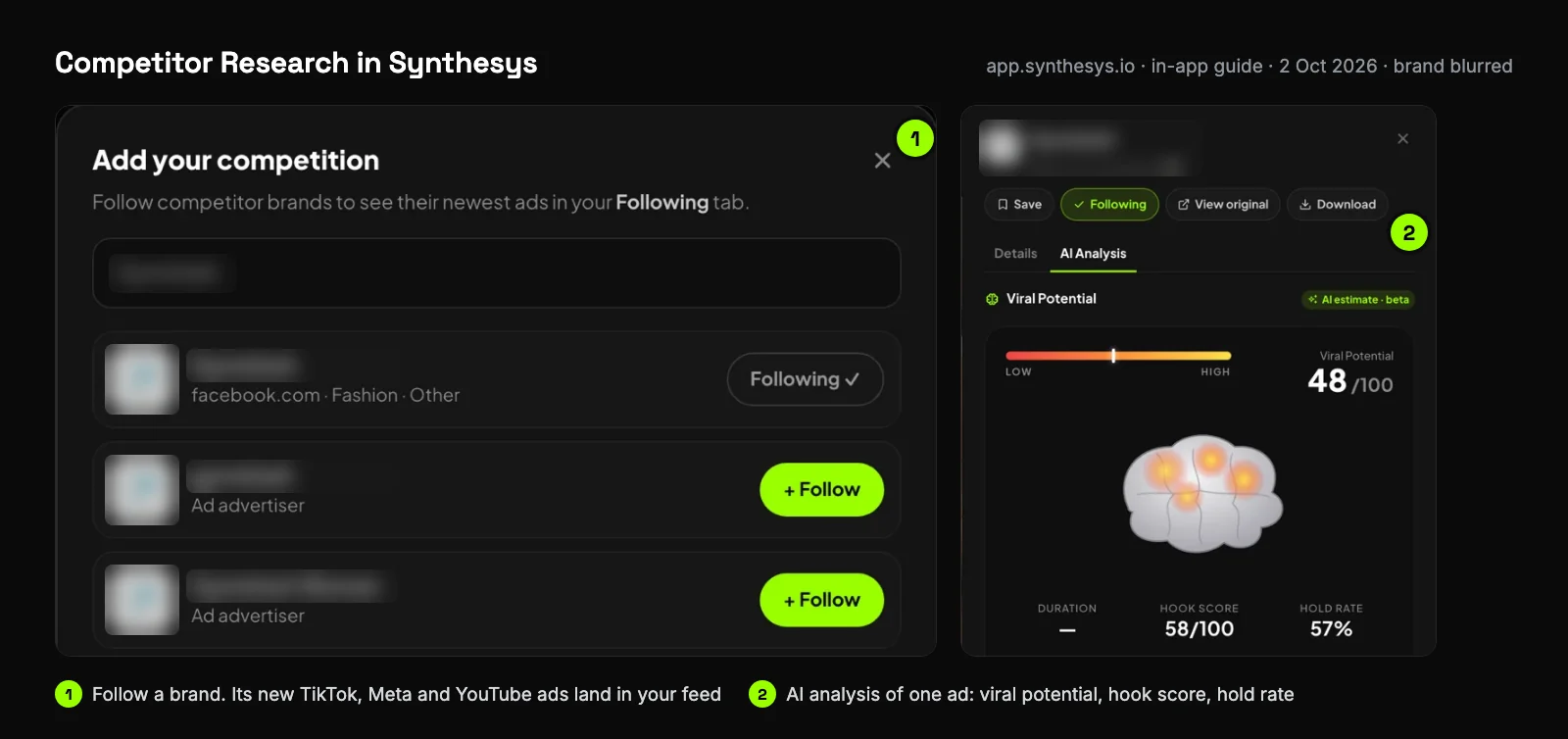
Start from what your competitors already run. In Competitor Research you follow a brand, and every new ad it runs on TikTok, Meta and YouTube lands in your feed. Open any ad for an AI read on its hook, hold rate and viral potential, then hand it to the agent to rebuild for your product. The feed and the analysis come with the Agency plan and up. Recreating an ad from its link works on every plan.
See the plan before you pay. We gave the agent the first test script above, word for word, and asked for a 20-second UGC ad in 9:16. In about two minutes it set the product, split the script into two handheld scenes and kept our wording. Nothing had rendered and no credits were spent. You can cast one of 748 library presenters or your own twin, made from one short clip. The render cost then shows on the approve button, and a cheaper video model brings it down (how the approval works).
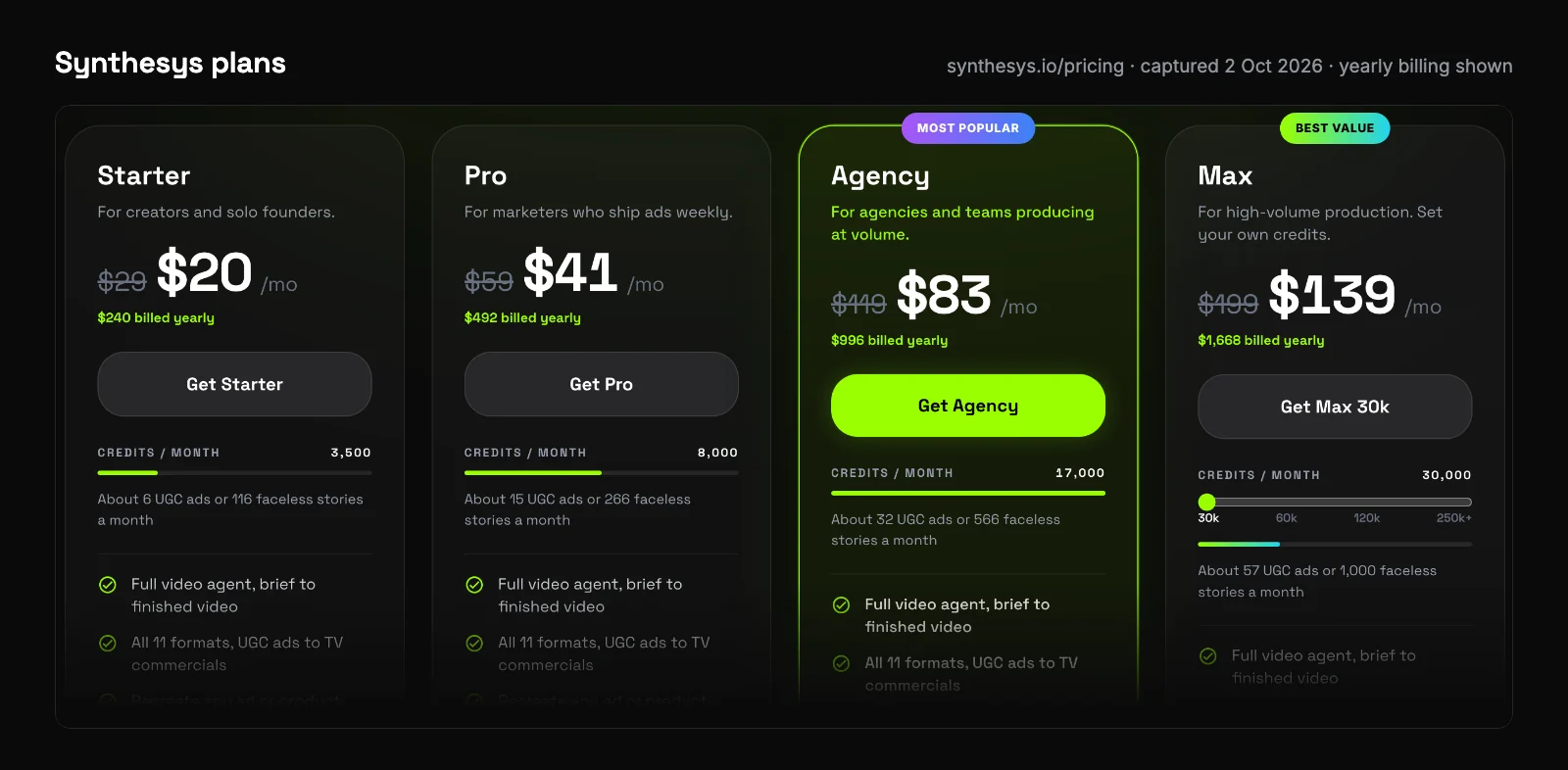
What it costs. Starter is $29 a month for 3,500 credits, Pro $59 for 8,000 and Agency $119 for 17,000. Max starts at $199. Yearly billing takes 30% off. A typical 15-second UGC ad uses about 522 credits, so Starter covers about six a month, and more on a cheaper video model. Scripts, storyboards, voiceover and music don't use credits, and every plan includes full commercial rights.
How to add Synthesys to your test. The reason to try it is simple: you see the whole plan and the price before you pay for a render, and a failed render costs nothing. Use the same product and scripts as the other three.
- Start a chat in Synthesys, paste script 1 and ask for a 20-second UGC ad in 9:16.
- Read the storyboard and fix anything in chat before you approve. Edits at this stage are free.
- Approve the render, then put the export next to the other three and compare voice, lip sync, credits and minutes.
If all you need is the same script read by dozens of stock actors, one of the three tools above is the simpler buy.
See the AI UGC video generator · Try Synthesys · See plans · What is an AI video agent?
For the B-roll models some of these tools run, see Seedance vs Kling.
For HeyGen against Higgsfield on avatar videos and ads, see Higgsfield vs HeyGen.
Which would we pick, and for what?
For most product ads, we'd start with MakeUGC or Creatify, because the price is public and the videos are yours. We'd pick Arcads when a team wants the most ways to make an actor move, and can work within its licence.
- An e-commerce brand testing hooks every week: MakeUGC. Batch Mode starts on Growth, and Pro adds products in hand.
- An agency with several clients: Creatify Pro, for separate Brand Spaces, the competitor tracker and the Ad Launcher.
- An app install campaign: Arcads, for its Show Your App tool and gameplay ad preset (guide).
- One finished ad from a product page or a competitor's ad, with the cost shown first: Synthesys (AI video agent).
- A first test with no budget: Creatify's free plan, watermark and all.
If we had to name one thing each does better: Arcads has the deepest set of actor tools. Creatify does the most once the video exists. MakeUGC is the clearest about what you'll pay.
Sources
All pages were opened and checked on 2 October 2026.
- Arcads, Homepage
- Arcads, Terms and Conditions (in force from 22 Sep 2026)
- Arcads Help, Everything You Can Do on Arcads
- Arcads Help, How to buy more credits? (30 Jul 2026)
- Arcads Help, Arcads Refund Policy
- Arcads Help, How to extend your videos? (30 Mar 2026)
- Arcads Help, How to Clone Yourself Into a Talking Actor? (4 May 2026)
- Arcads Help, What Languages Are Supported by Arcads? (2 Jul 2026)
- Arcads Help, Arcads.ai API Documentation (16 Apr 2026)
- Arcads Help, Arcads MCP (26 Jun 2026)
- Creatify, Homepage
- Creatify, Pricing and FAQ
- Creatify, AI Avatar
- MakeUGC, Homepage
- MakeUGC, Pricing and FAQ
- MakeUGC, Custom AI avatar
- MakeUGC, Platform API docs and Rate limits
- MakeUGC, Terms of Service (effective 17 Nov 2025)
- HeyGen, Pricing
- US Federal Trade Commission, Final rule banning fake reviews and testimonials (14 Aug 2024)
- Synthesys, AI Video Agent
- Synthesys, Pricing
- Synthesys app: the Competitor Research guide, the character library and our storyboard for test script 1, captured 2 October 2026