Ad Analysis: Break Down and Rebuild Competitor Video Ads
Ad analysis for video, tested step by step: find competitor video ads in free ad libraries, read the signals, score the hook and rebuild the winner as your own.
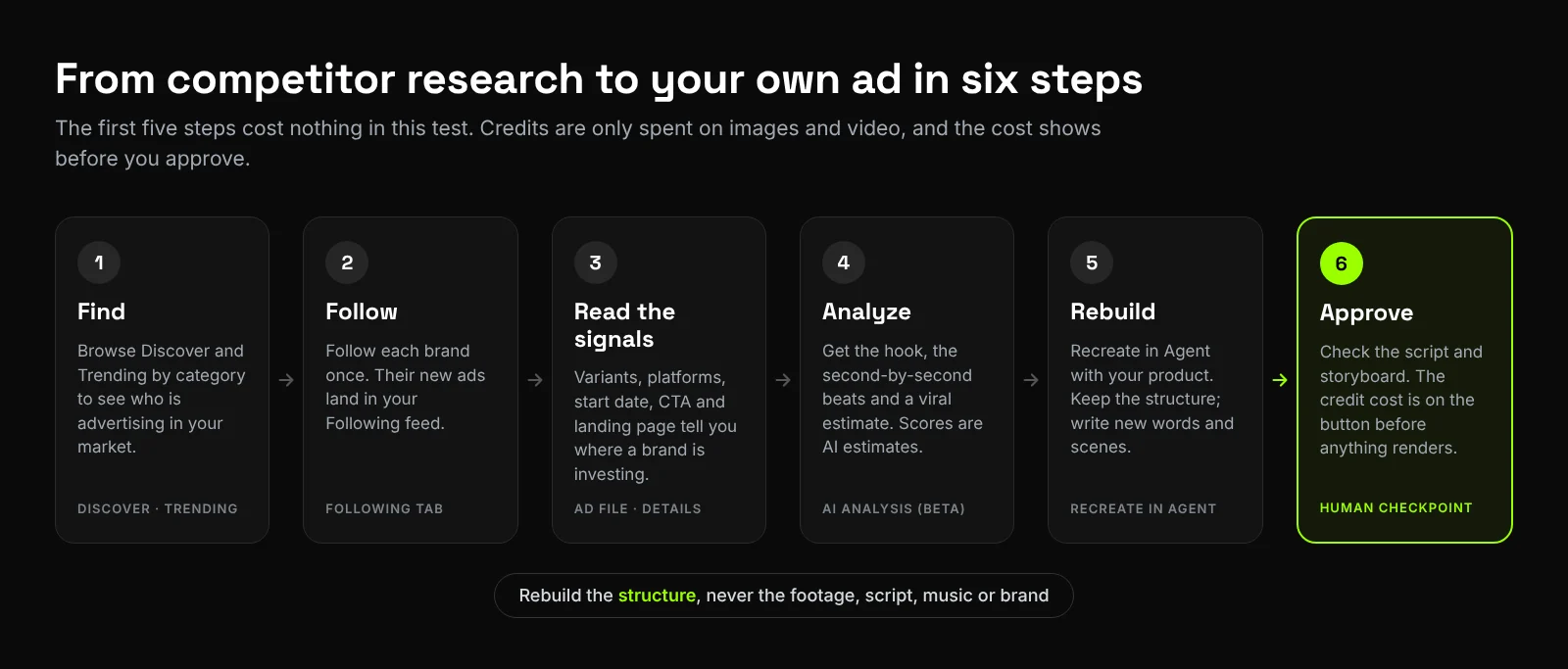
Do you know which ads your competitors are running this week? Most marketers check the Meta Ad Library once, screenshot a few ads, and then the folder goes cold.
We've built AI voice and video tools since 2020. We built competitor research into the agent because customers kept asking the same thing. What is working for the brand next door, and can I make my version today?
This post walks through one real ad analysis in the Synthesys app on 2 October 2026, and every screenshot comes from it. We researched two nutrition brands, Huel and AG1, and picked one ad worth learning from. Then we rebuilt its structure around Fuelbar, a sample snack bar we made up for the test.
What is ad analysis?
Ad analysis is taking an ad apart to see why it works, or why it doesn't. Your own ads start from your account's numbers. Competitor ads only show the creative and public signals, so you study the hook, beats, format and how hard the brand pushes it.
| Kind of ad analysis | What you study | Data you have | The question it answers |
|---|---|---|---|
| Performance analysis | Your own campaigns | Your ad account: click-through rate, cost per result, return on ad spend | Which ad gets more budget? |
| Creative analysis | Any ad, yours included | The ad itself: hook, beats, format, pacing | Why does this ad hold attention? |
| Competitor ad analysis | Your rivals' ads | Ad libraries: start date, variants, platforms | What are they investing in, and what can we learn? |
Most top-ranking guides on ad analysis cover the first row: metrics and reports. This one covers creative and competitor ad analysis for video ads.
A static ad is one image and one line. A video ad is a sequence, so the useful unit is the beat.
Which free ad libraries show competitor video ads?
Five free ad libraries show live competitor video ads. Meta, LinkedIn and TikTok each run one, TikTok adds Top Ads, and Google's Ads Transparency Center covers YouTube. They show what ran, where and when, but none shows sales and only some show reach.
We checked each one with Huel and AG1 on 2 October 2026.
| Library | What we could see | What it doesn't show |
|---|---|---|
| Meta Ad Library (the Facebook ads library) | Start date, platforms, ad copy, call to action, how many ads share the same creative. For ads that reach the UK or EU, Meta adds targeting and who was served the ad | Spend, clicks or sales. Ads shown only elsewhere, such as US-only ads, appear while active and vanish when they stop, with no reach or targeting |
| TikTok Ad Library | Ads shown in the EEA, the UK, Switzerland and Turkey in the past year, with first and last shown dates and a band of unique users. Huel had 712 ads shown in the last 30 days | Ads shown only outside those regions. We found none for AG1 or Athletic Greens in the same 30 days |
| TikTok Top Ads | High-performing ads filtered by region, industry and objective, with likes, a CTR band and a budget band | Ads the advertiser didn't authorize. Our searches for Huel and AG1 returned no matching ads |
| Google Ads Transparency Center (covers YouTube) | Verified advertiser, legal name, country, roughly how many ads, filters for YouTube and video, the last date each ad was shown | Performance, and targeting outside the regions Google lists |
| LinkedIn Ad Library | Search by company, payer, keyword, country and date; the advertiser and who paid | Results. For Huel we only found recruitment ads |
So there's a free video ads library for every major platform. None follows a brand for you, and all stop before the useful part: turning an ad into a plan for your own.
How do you find your real competitors?
Your real competitors are the brands your buyers see in the same feed, not only the companies on your list. Search by category first, then add the brands that keep appearing, plus anyone bidding on your search terms in Google's Transparency Center.
In Synthesys, the research library sits next to the agent under Competitor research. We opened Discover and filtered to Health/Wellness. It returned 24+ live ads from brands we hadn't listed.
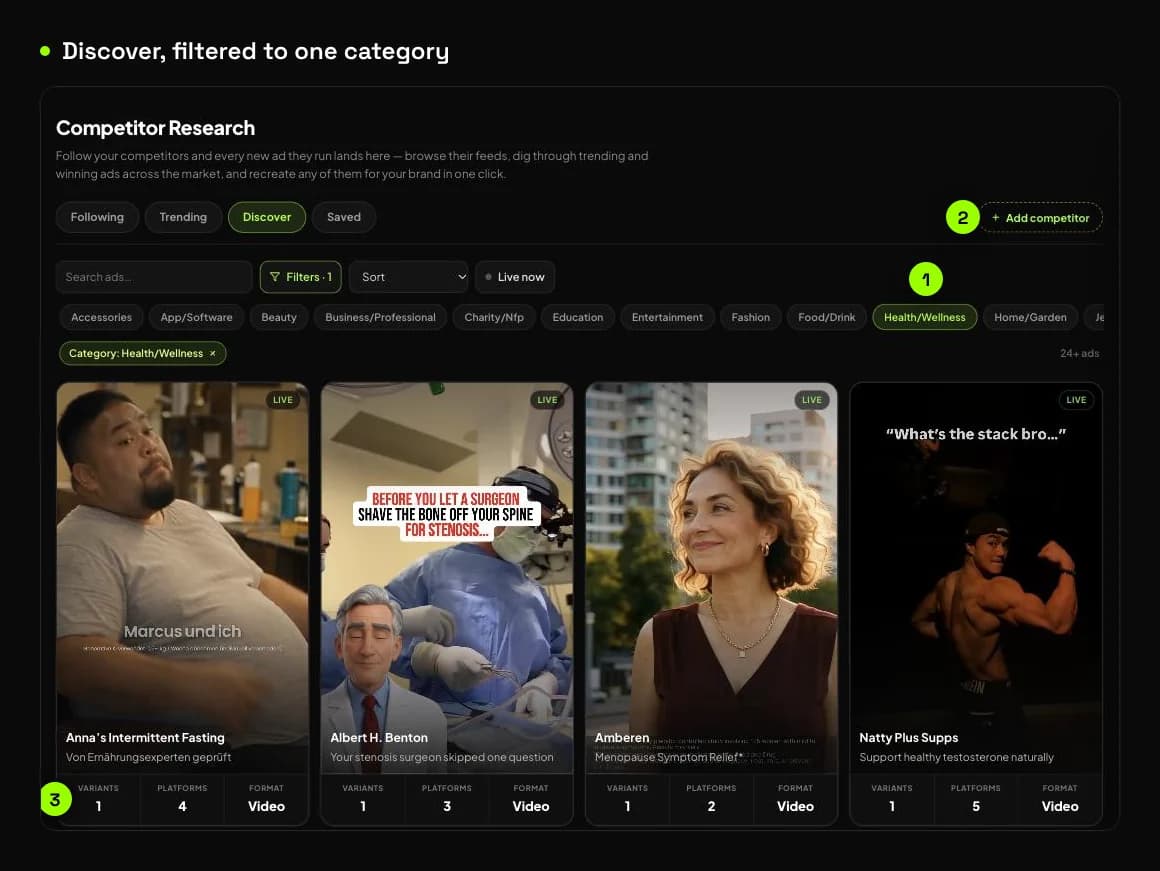
Each card shows variants, platforms and format, enough to spot who is spending before you open an ad.
Trending was nearly empty until we followed brands, so start with Discover.
How do you follow competitors' new video ads?
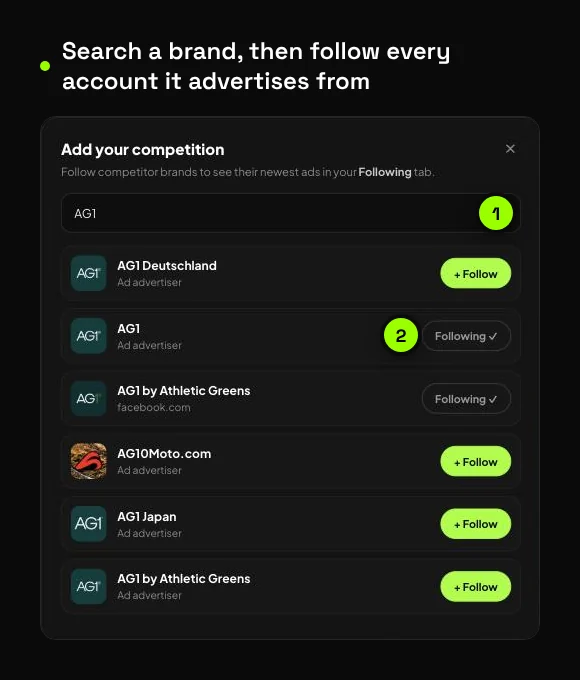
Follow each brand once and its new ads land in a Following feed, grouped by brand. Search every account a brand advertises from. In our test, Huel showed up as four accounts, including one for TikTok, and AG1 showed up as five.
We clicked Add competitor, searched each name and followed two accounts per brand. Following all four took under a minute.
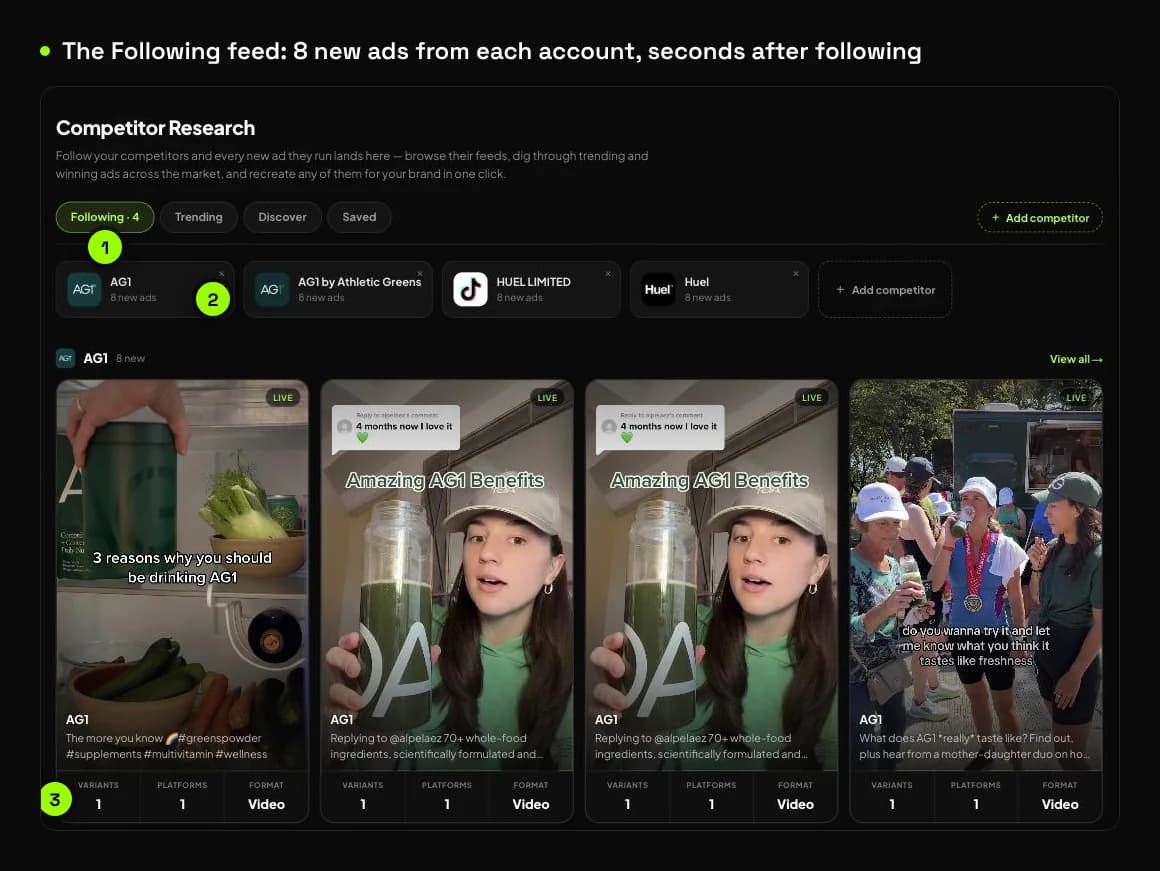
The Following tab filled within seconds: eight new ads per account, each marked Live. Saved holds the ads you want to come back to.
I check the Following tab every Monday before we plan the week's ads. If a brand launches five variants of one idea, that idea goes on our test list.
Then I wait a few weeks. The ads that keep running are the ones with the best odds of winning. Every ad also has an expiration date, so we keep that in mind: every ad we replicate supports a fresh concept.
Do you need an ad spy tool for video ads?
Not to see what's running, because the ad libraries are free. A spy tool earns its place when you track many brands every week. For video, judge it on platforms covered, new ads collected for you, beat-by-beat breakdowns and a way to act on them.
| Job | Free ad libraries | Synthesys |
|---|---|---|
| See what a brand is running | Yes, one platform and one search at a time | Meta and TikTok ads in one feed, by brand |
| Get new ads without searching again | No | Following feed, grouped by brand |
| Break a video into beats | No | AI Analysis and the creative breakdown (estimates) |
| Turn an ad into your own | No | Recreate in Agent, with the cost shown before anything renders |
That first row is the biggest difference. Huel's Meta ads and its TikTok ads sat side by side in one feed. Each ad file listed the Meta placements it ran on, such as Facebook, Instagram, Messenger and Threads.
Whatever you use as your video ad spy, keep the routine fixed. Check the same brands on the same day each week and log what's new, what stopped and which ideas gained variants.
What can an ad's file tell you, and what can't it?
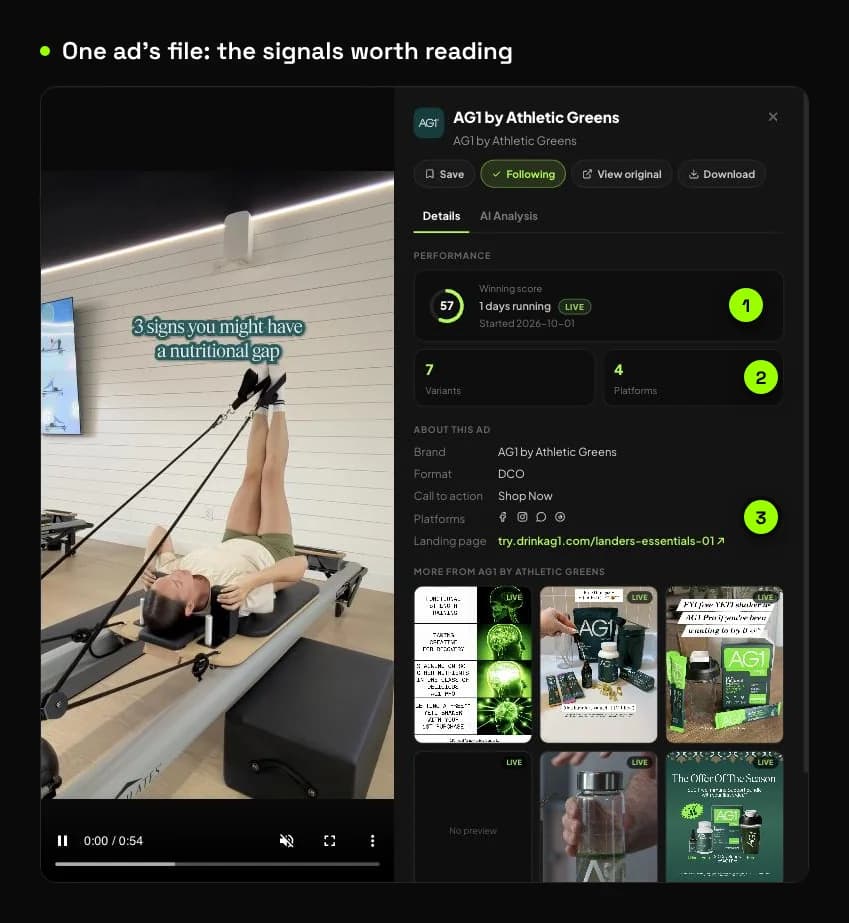
An ad's file shows how hard a brand is pushing it: variants, platforms, start date, call to action and landing page. It can't show profit or sales. Read these as signals of investment, then test the idea with your own product.
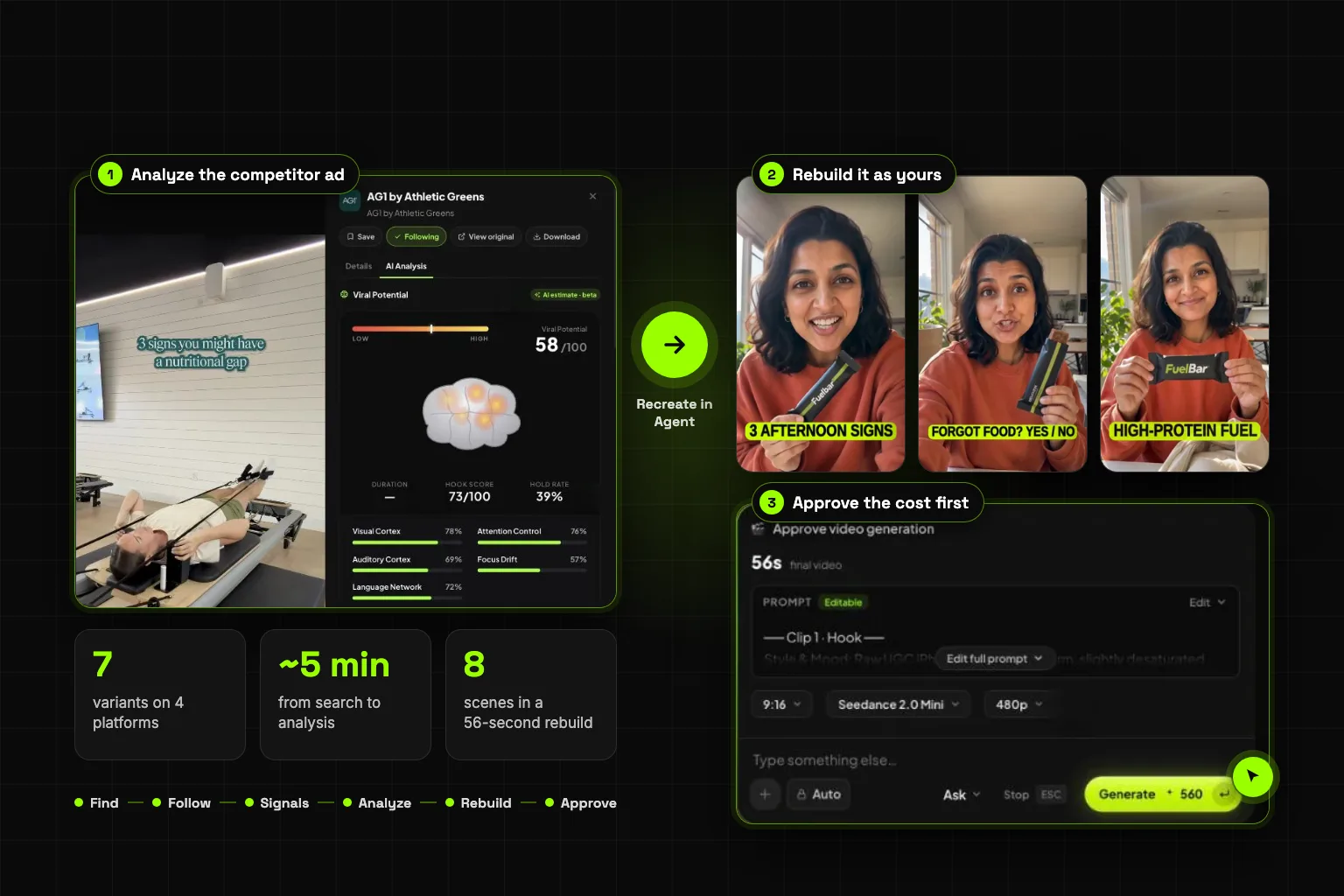
We opened AG1's "3 signs you might have a nutritional gap" ad. It had 7 variants across 4 platforms, a Shop Now button and a dedicated landing page. It had started the day before.
| Signal | Where you see it | What it suggests | What it doesn't prove |
|---|---|---|---|
| Variants | Ad file, Meta "ads use this creative" | The brand is testing versions of one idea | That any version is profitable |
| Platforms | Ad file, Meta, Google filters | Budget behind it on more than one channel | Which platform performs |
| Start date and days running | Ad file, Meta, TikTok and Google "last shown" | Long runs suggest the ad keeps earning its budget | A short run can still be a winner just launched |
| Call to action and landing page | Ad file, Meta | Where the funnel goes next | Conversion rate |
| Winning score | Synthesys ad file | A model's read of the creative | The advertiser's results |
The signal I trust most is variants: brands don't make seven versions of an idea they've given up on. I also watch the attention scores and how many days an ad has been running. The one that misleads people is a single viral-looking ad with no variants, because it may never have scaled.
How do you analyze a video ad, step by step?
Break the ad into beats: the hook in the first three seconds, the problem, the proof, the offer and the call to action. Then note the format and pacing. An AI breakdown speeds up the ad analysis, but its scores are estimates, not the advertiser's data.
We opened AI Analysis on the AG1 ad. It cost no credits in our test. A first read appeared in about three seconds, then the panel refined itself over roughly a minute.
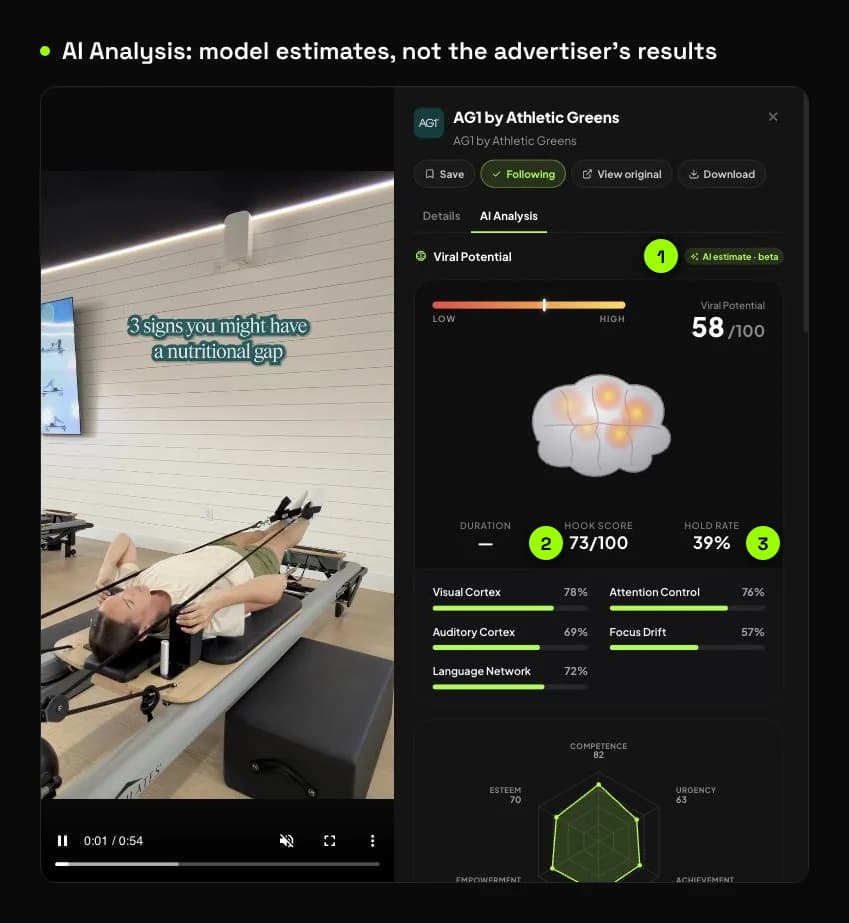
The numbers moved while it refined: hold rate went from 76% in the first read to 39% in the final one. The app says it plainly under the panel: "Scores are modeled from the creative (hook, pacing, structure) and its reach signals — not real ad-account metrics."
The part we used most was the creative breakdown. It named the hook, explained why the structure works and listed every beat with its timing and voiceover.
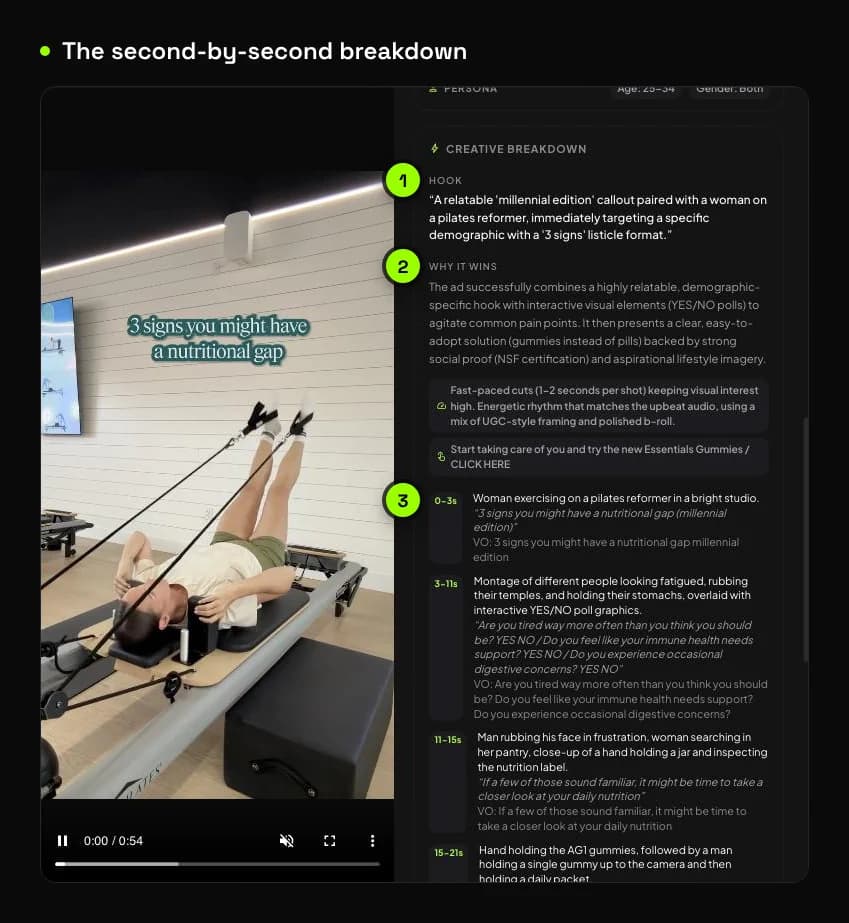
Whether you use AI or a notepad, a video ad analysis covers the same seven things:
- Hook (0 to 3 s): what stops the scroll. Here, a "3 signs" list aimed at one age group.
- Problem: the pain the ad names. Here, three yes/no questions.
- Reframe: the line that turns the problem toward a solution.
- Proof: what makes the claim believable, such as a certification, a demo or a review.
- Offer and call to action: what the viewer is asked to do.
- Format and pacing: UGC or polished, cuts per second, captions, length.
- Landing page: where the click goes and whether it matches the ad.
How do you rebuild a winning ad around your product without copying it?
Keep the structure and replace everything else: the product, the words, the scenes, the people, the music and the brand. In Synthesys you click Recreate in Agent, describe your product, check the storyboard and approve the cost before anything renders.
From the ad file we clicked Recreate in Agent. The app converted the AG1 ad into a text reference in about a minute and estimated the cost before we sent anything.
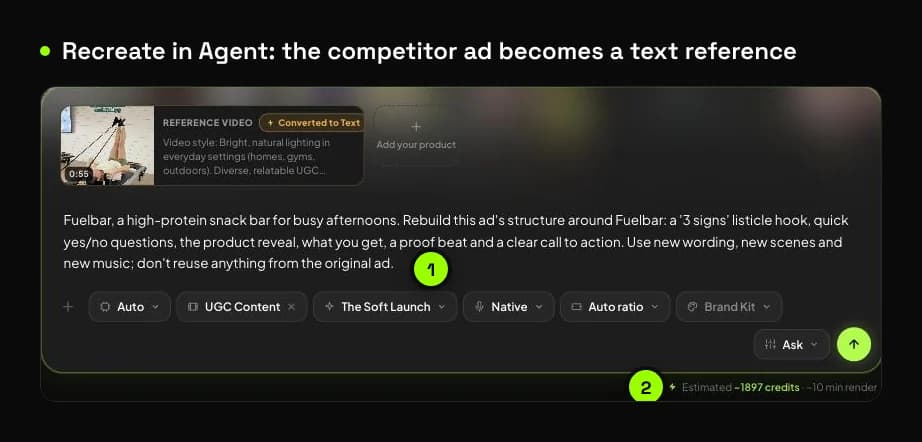
Our brief asked for the same beats with new wording, new scenes and new music. The agent asked one question first: what does the product look like, and which claims may it use? We described the wrapper and kept the claims simple.
The app's Video Clone templates offer more ways in. Five were live on the day of our test and three were marked "soon".
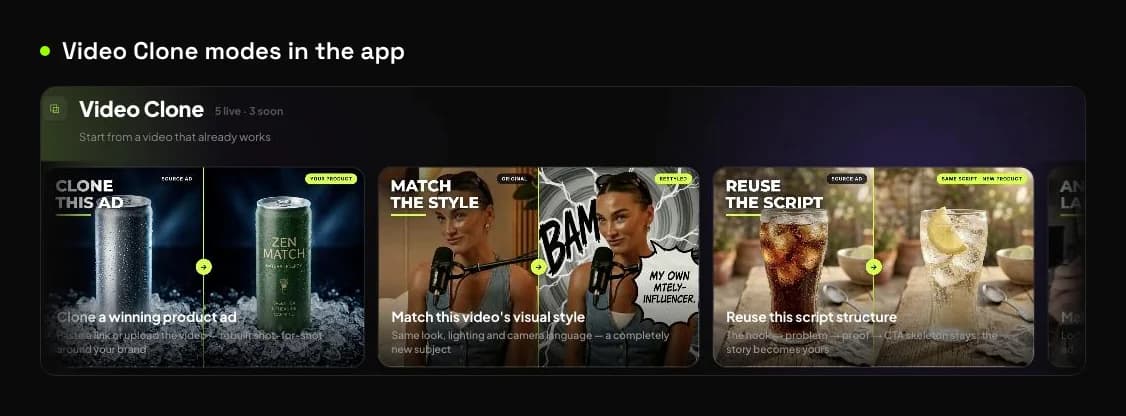
| Mode in the app | What it keeps | When to use it |
|---|---|---|
| Clone this ad | The scene-by-scene plan | Your product fits the same story |
| Match the style | Look, lighting and camera language | You like the feel, not the message |
| Reuse the script | The hook, problem, proof and CTA skeleton | The safest way to learn from an ad without copying it |
| Any language | The whole ad, localized | Taking your own ad to a new market |
| Cast yourself | The format, fronted by your own twin | Recreating a creator-style video as yourself |
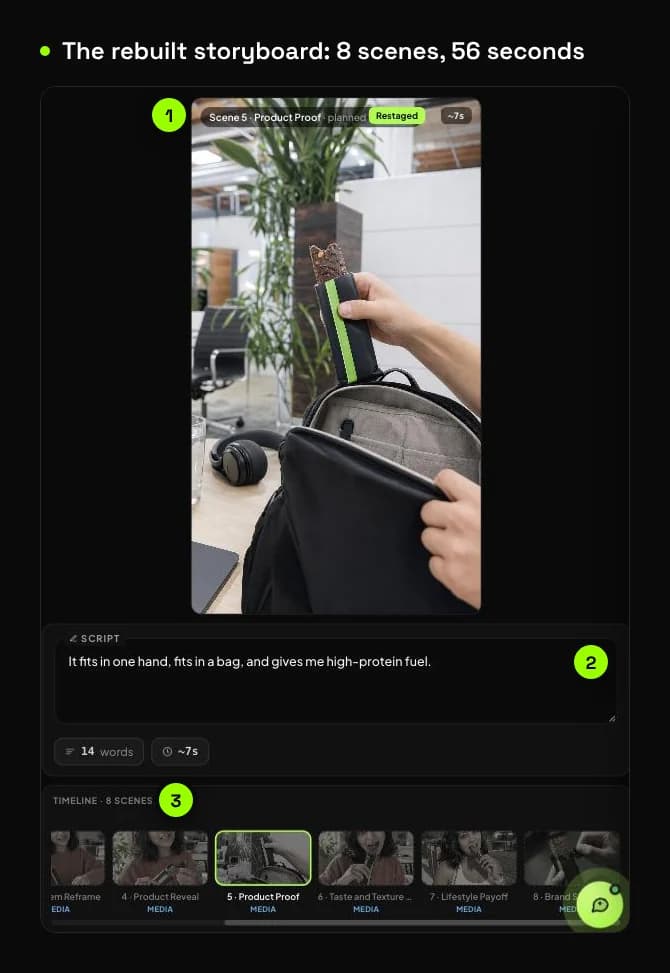
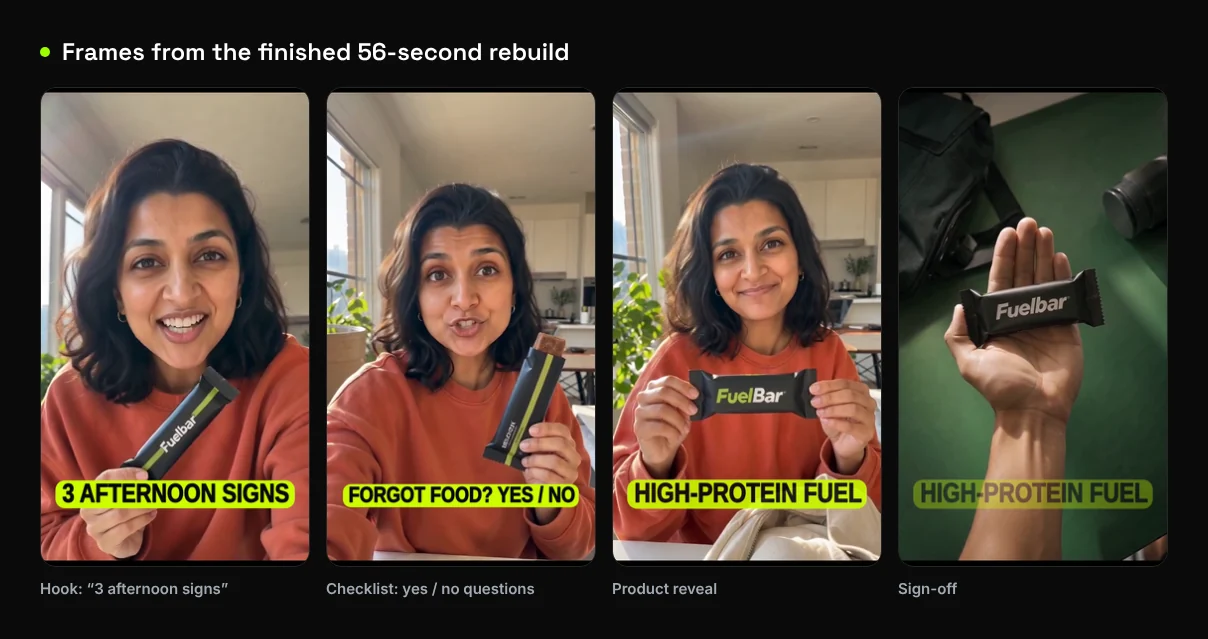
The agent planned eight scenes and a 56-second cut, cast one presenter, then drew a frame for every scene.
| Kept from the AG1 ad | Changed for Fuelbar |
|---|---|
| A "3 signs" list as the hook | New product, new presenter, new settings |
| Yes/no questions to name the problem | New questions about the afternoon slump |
| Reveal, proof, payoff, call to action | New lines, new scenes, new music |
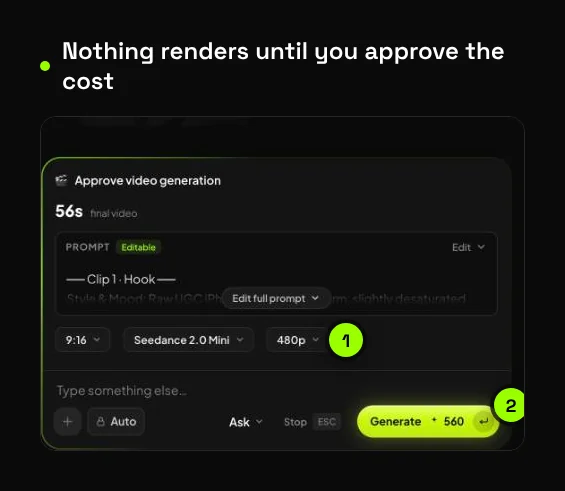
Every step that spends credits stopped for approval and showed its cost first. Casting the presenter cost 7 credits and the eight frames cost 288.
The final render showed 1,848 credits with the default model at 720p. We switched to a lighter model at 480p and the button dropped to 560.
The render took about seven minutes. Four frames from the finished rebuild:
AG1's live ads are in the Meta Ad Library under AG1 by Athletic Greens.
My line is simple: if a viewer could mistake your ad for theirs, you copied it. Borrow the order of the beats, never the footage, the script, the music or the brand.
Is it legal to research and rebuild competitor ads?
Researching is fine, because the ad libraries are public by design. Rebuilding a structure is generally fine too, since copyright doesn't protect ideas or methods. Copying the footage, script, music, logo or people is where the risk starts (this isn't legal advice).
Meta says its EU ad archive exists so that "anyone, anywhere" can understand the ads that run. The US Copyright Office says copyright doesn't protect "any idea, procedure, process, system, method of operation, concept", in whatever form it's described.
It does protect the expression: the video, script, music and brand assets. That's why our brief asked for new wording, scenes and music.
Testimonials are a separate risk. The FTC's final rule bans fake reviews and testimonials, including AI-generated ones from people who don't exist. If a competitor's ad uses a customer story, your rebuild needs a real one of your own.
What are the limits of ad analysis?
The libraries miss ads, the AI scores are estimates and the research feed needs the Agency plan. In our test, the agent also needed a product photo to keep the logo right, and one script line needed a human read before approval.
- Library gaps. TikTok's Ad Library only covers ads shown in the EEA, the UK, Switzerland and Turkey, and Top Ads only shows ads advertisers chose to share. Our searches found Huel in the first and no AG1 ads in either. Outside the UK and EU, Meta shows no reach or targeting for regular ads and drops them once they stop.
- Estimates, not results. The AI Analysis hold rate moved from 76% to 39% while it refined. Use the scores to choose what to test.
- Plan and platforms. The research feed and AI Analysis come with the Agency plan and up; cloning from a link works on every plan. The feed covered Meta and TikTok in our test, so check YouTube and LinkedIn ads in Google's and LinkedIn's libraries.
- No product photo, no consistent logo. We only described Fuelbar in text. The storyboard frames showed no wordmark, and the video drew one that changed between shots, including "Fuelar" and mirrored text. Upload a product photo or set your Brand Kit before the frames.
- Read the script before you approve. The hook promised three signs, but the scene 2 script listed two and the scene 3 line was cut off. The final video showed three questions on screen, but the script needed a human check.
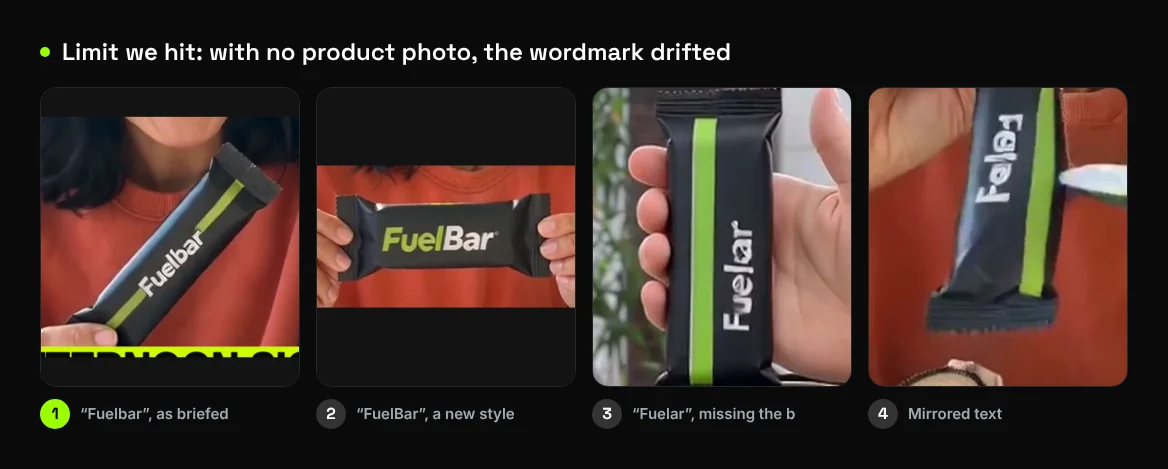
The limit I'd warn about first is the product shot: give the agent a real photo of your pack, or it will draw its own.
Try it
Synthesys is an AI video agent that replaces traditional video production end to end.
Follow your competitors in the research feed on the Agency plan and up. On any plan, paste an ad link into the agent and rebuild its structure around your product. The storyboard and credit cost show before anything renders.
Open the Synthesys app · Read What Is an AI Video Agent? · See the AI video agent, the AI video ad generator, the Facebook ad generator and the TikTok ad generator · Learn how AI video credits work
Sources
All opened on 2 October 2026.
- Meta, New Features and Additional Transparency Measures as the Digital Services Act Comes Into Effect, 22 August 2023
- Meta Business Help Center, About the Meta Ad Library
- TikTok, Commercial Content Library FAQs
- TikTok for Business, About Top Ads, updated May 2025
- Google, Ads transparency, Advertising Policies Help
- US Copyright Office, Circular 33: Works Not Protected by Copyright, revised March 2021
- Federal Trade Commission, Federal Trade Commission Announces Final Rule Banning Fake Reviews and Testimonials, 14 August 2024
- Synthesys, AI Video Agent product page
- The Meta Ad Library, TikTok Ad Library, TikTok Top Ads, Google Ads Transparency Center and LinkedIn Ad Library, checked with Huel and AG1
- First-hand test in the Synthesys app, 2 October 2026: Huel and AG1 followed, one AG1 ad analysed, and a 56-second rebuild for a sample product
Frequently asked questions
What's the difference between ad analysis and competitor ad analysis?
Is there a free video ads library?
Can I copy a competitor's ad?
Are AI ad analysis scores the advertiser's real results?
Can I see a competitor's Facebook and TikTok ads in one place?
How long does ad analysis take?
Keep reading
All posts →
What Is a VSL? How to Make a Video Sales Letter With AI
Synthesys Studio: 35 AI Models for Image, Video and Voice
AI Whiteboard Video: From Script to Final Cut in 6 Steps